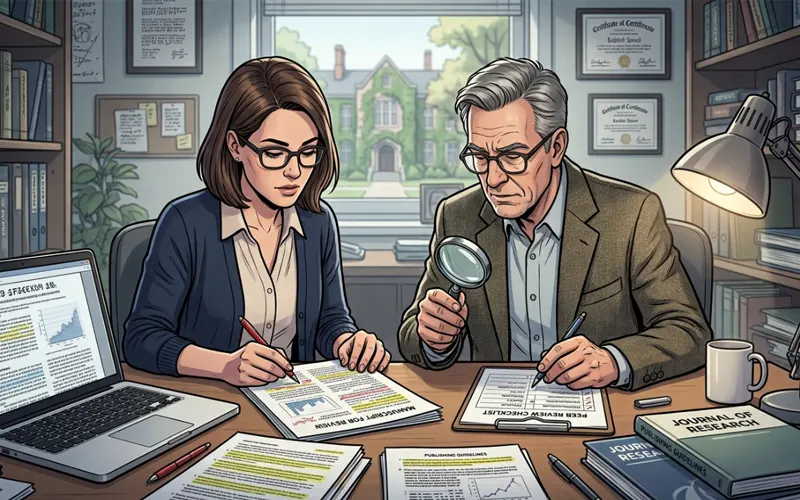
The Complete Guide to Peer Review Before Journal Submission
One of the biggest goals as a researcher is to publish the research in a reputable academic journal. Nevertheless, even the best studies may be rejected if the manuscript has not been properly revised before submission. For this reason, pre-submission peer review has become an important part of the publication process.
As a first-time researcher, a postgraduate student or even an experienced academic, it may be of great importance to understand how peer review works, as this will greatly enhance your chances of being published. Many researchers use journal publishing services and professional peer review services to improve their manuscripts before submitting them to target journals.
In this handbook, we will clarify all that you should know about pre-submission peer review and its importance.
Table of Contents
ToggleWhat Is Peer Review?
Peer review refers to the review of a research article by individuals who are experienced and knowledgeable in the same field. They are to evaluate the quality, originality, methodology, accuracy and general contribution of the research.
Peer review is traditionally done after a manuscript has been sent to a journal. Nevertheless, most writers are now requesting an independent review before their submission to establish areas of weakness and enhance the paper beforehand.
An effective review can identify problems that might otherwise lead journal editors to reject the manuscript immediately.
Why Peer Review Before Journal Submission Is Important
Numerous journals rebuff manuscripts before their external review. This first rejection is usually due to preventable problems like lack of clarity in writing, faulty methodology, inappropriate formatting, or lack of support by literature.
There are several advantages to having a peer review before submission:
- Enhances the quality of the paper.
- Spots logical inconsistencies and unsubstantiated assertions.
- Strengthens research arguments.
- Identifies formatting and language problems.
- Maintains journal guidelines.
- Builds confidence before submission.
After taking time to work on their manuscripts, researchers frequently find the publication process easier.
What Reviewers Usually Look For
Knowledge of the review criteria will assist authors in writing better manuscripts. When it comes to the review process, there are several important areas which are normally evaluated by the experts.
Originality
The editors and reviewers desire research that will add new knowledge or give new insight. The novelty and significance of a manuscript should be made clear.
Research Methodology
The methodology used must be suitable, precise and scientific. Weak or incomplete approaches tend to lead to adverse reviewer remarks.
Literature Review
An effective literature review shows that you are conversant with other studies and that you are filling a gap in your study.
Data Analysis
Reviewers assess whether the data adequately support the analysis, interpretation and conclusions.
Structure and Clarity
An organised manuscript is simple to comprehend. Readability is enhanced by clear headings, logical flow and concise writing.
References
Correct referencing style and appropriate references show academic honesty and enhance credibility.
Common Reasons Journal Manuscripts Get Rejected
There are lots of rejections that are not related to the topic of research. Rather, they are caused by preventable errors like:
- Low quality of English language.
- Weak research design
- Insufficient statistical analysis
- Incomplete literature review
- Not adhering to journal formatting rules.
- Lack of originality
- Unsupported conclusions
- Plagiarism or referencing problems.
Professional peer review services will be used to detect most of these issues even before the manuscript is submitted to journal editors.
How Journal Publishing Services Help Researchers
Publication of research is far beyond writing a paper. Authors also need to identify appropriate journals, prepare submission documents, format manuscripts in the appropriate way and also answer the comments of reviewers.
Professional journal publishing services simplify the process by supporting authors at different stages of publication.
These services can include:
- Journal selection assistance
- Manuscript formatting
- Language editing
- Technical editing
- Reference checking
- Similarity checking
- Pre-submission peer review
- Submission support
These do not substitute for the author’s research; they assist in offering it in the best manner possible.
Benefits of Professional Peer Review Services
Receiving feedback from independent subject experts offers considerable benefits.
Objective Evaluation
Writers tend to ignore flaws in their own writing. Outside auditors give objective comments that can aid in quality improvement.
Better Academic Writing
Positive recommendations have the potential to enhance clarity, logicality and readability without altering the research results.
Higher Publication Readiness
A thoroughly reviewed paper is more likely to be ready for editorial consideration.
Reduced Risk of Rejection
Although no service can guarantee publication, addressing reviewer concerns before submission can reduce the risk of avoidable rejection.
Improved Research Impact
Properly presented research will have better chances of conveying its findings to the editors, reviewers and readers.
Choosing Reliable Peer Review Services
Not all review providers are equally skilled. Researchers are to consider:
- Subject-specific reviewers
- Transparent review process
- Academic publishing experience
- Confidentiality policies
- Detailed reviewer reports
- Realistic turnaround times
Any services offering guaranteed publication should be avoided because publication is always at the mercy of the editorial and peer-review process of the journal.
Tips Before Submitting Your Manuscript
Before clicking the submission button, fill in the following checklist:
- Read the author guidelines of the journal.
- Check references and citations.
- Check grammar and language quality.
- Make sure that tables and figures are properly labelled.
- Check that the level of plagiarism is acceptable.
- Review statistical analyses.
- Ask others to give independent feedback (where feasible).
- Check the final version.
Even experienced researchers benefit from a final review before submission.
Final Thoughts
What it takes to publish in academic journals is more than just quality research. The manuscript should present the findings clearly, maintain a high academic standard and comply with the journal’s requirements. A pre-submission review can also be an effective way of investing time to enhance the quality of the manuscript and enable researchers to diagnose the weaknesses early before they are detected by the editors.
Whether it is your first research paper or a high-impact journal submission, you may find professional peer review services and reliable journal publishing services helpful to guide you through the publication process. Polishing the manuscript before submission places the research in a stronger position for editorial consideration and improves its clarity, credibility and scholarly impact.
Frequently Asked Questions
1. What is peer review before journal submission?
Peer review before journal submission is the process of having a research manuscript evaluated by an experienced expert before submitting it to an academic journal. It helps identify weaknesses and improve the overall quality of the paper.
2. Why is peer review important before submitting a research paper?
Pre-submission peer review helps researchers find errors in methodology, writing, data analysis, references, and structure. It can also reduce the risk of rejection due to avoidable mistakes.
3. What do peer reviewers usually check?
Peer reviewers commonly evaluate originality, research methodology, literature review, data analysis, structure, clarity, references, and the overall contribution of the research.
4. Can peer review guarantee journal publication?
No. Peer review cannot guarantee publication. The final decision is always made by the journal’s editors and reviewers according to the journal’s standards and requirements.
5. What are common reasons research papers get rejected?
Common reasons include weak research methodology, poor English, insufficient statistical analysis, incomplete literature reviews, lack of originality, unsupported conclusions, formatting issues, and plagiarism or referencing problems.
6. Can professional peer review services improve a manuscript?
Yes. Professional peer review services can provide independent feedback that helps researchers improve the clarity, structure, methodology, references, and overall presentation of their manuscripts.
7. What should researchers check before submitting a manuscript?
Researchers should check the journal’s author guidelines, references, grammar, formatting, tables and figures, plagiarism or similarity, statistical analysis, and the final version of the manuscript.
8. How can journal publishing services help researchers?
Journal publishing services can assist with journal selection, manuscript formatting, language and technical editing, reference checking, similarity checking, pre-submission peer review, and submission support.