


Watts and watt-hours appear beside each other on solar generator specifications, but they answer completely different questions. Watts describe the rate at which power moves at a given moment. Watt-hours describe an amount of energy stored or consumed over time. Understanding that distinction makes specifications far more useful. It explains why a large battery does not automatically determine which appliances a power station supports, and why a strong output rating does not reveal runtime. Both measurements need to be read together.
Think of Watts as Power in the Moment
W Tells You How Much Power an Appliance Demands
A watt measures power at a particular moment. When an appliance carries a 100W rating, it requires power at roughly that rate while operating under the stated conditions. A 1,000W appliance creates a much larger immediate demand. Solar generator output ratings use the same unit, so buyers can compare the appliance requirement with what the power station is designed to deliver. The Anker SOLIX S2000 provides 1,500W rated AC output. Anker’s supplied appliance examples include a 700–1,000W microwave, 900–1,300W coffee maker, and 800–1,500W kettle. These watt figures describe power demand, not how much total energy each appliance will consume during an entire trip, outage, or evening.
Rated and Peak Watts Answer Different Questions
Solar generator specifications may show more than one watt figure because electrical demand is not always perfectly constant. Rated output describes the power level intended for regular operation, while peak output represents a higher short-duration capability. The S2000 lists 1,500W rated AC output and 3,000W peak output. Anker states that this allows it to power 99% of essentials. When evaluating a portable solar power generator, buyers should therefore identify the normal operating wattage of their intended equipment and consider any relevant temporary power demand. This is especially useful when several devices may operate at once. Adding their watt requirements provides a clearer view of the combined load the station may need to support at that moment.
Input Watts Describe Charging Speed, Not Battery Size
Watts also appear on the charging side of a power station, which creates another potential source of confusion. A 400W solar input rating does not mean the battery stores 400Wh. Instead, it describes supported incoming power. The S2000 supports up to 400W solar input and up to 1,600W AC input. Anker states that 400W solar input can recharge the unit to 80% in 4.5 hours under the specified conditions. A 1,600W wall outlet in UltraFast Mode can reach 80% in 1.2 hours. These figures belong to the charging process. When reading a specification sheet, separating input watts from output watts immediately makes the numbers easier to interpret: one concerns energy entering the station, while the other concerns power supplied to connected equipment.
Use Watt-Hours to Put Time Into the Equation
Wh Connects Power With Duration
A watt-hour measures energy rather than instantaneous power. The basic relationship is simple: watts multiplied by hours equal watt-hours. A device drawing 100W for two hours would theoretically consume 200Wh. A 500W device operating for half an hour would use 250Wh. Real systems also involve operating conditions and efficiency, so this arithmetic works best as a planning estimate rather than an exact runtime promise. The Anker SOLIX S2000 has a stated capacity of 2,010Wh. That number describes its stored-energy capacity, not its output strength. Once buyers understand this distinction, the specification sheet becomes much more informative: 2,010Wh answers “how much energy,” while 1,500W rated output answers “how much power at once.”
Runtime Makes Watt-Hours Easier to Visualize
Raw capacity becomes more intuitive when translated into familiar devices. Anker lists several runtime examples for the S2000 under its stated conditions. A 100W television is listed at 17 hours, while a 10W Wi-Fi router is listed at 81 hours. The company also gives an example of 20 charges for a 60W laptop and up to 35 hours of refrigerator backup. These examples show why runtime cannot be predicted from watts alone. Two appliances may both work within the station’s output capability while consuming stored energy at very different rates. The same 2,010Wh battery can therefore support many hours of a lighter load or a shorter period of a more energy-intensive one.
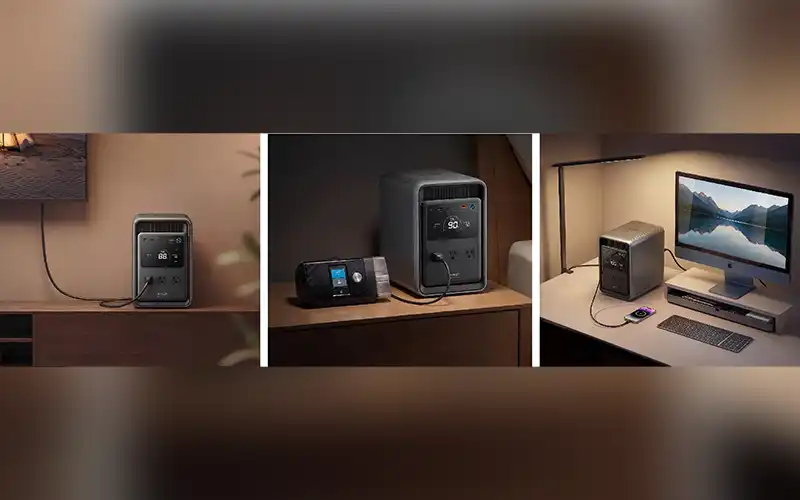
Watts indicate how much power connected appliances require while operating.
Put W and Wh Together for a Complete Power Plan
The clearest way to plan solar generator use is to ask two questions for every device. First, does its wattage fit within the station’s output capability? Second, how many watt-hours will it consume over the planned operating period? Suppose several devices all fall within the available output rating. Their operating duration still determines how quickly they draw from stored capacity. Conversely, a battery may contain plenty of watt-hours while the generator’s output rating determines which loads it can supply at once. The S2000’s 1,500W rated output and 2,010Wh capacity illustrate these separate roles clearly. Once both measurements enter the calculation, users can estimate appliance compatibility and energy duration instead of relying on either specification by itself.
Conclusion
W and Wh describe two different parts of solar generator performance. Watts measure power at a moment and apply to both appliance demand and charging input. Watt-hours measure energy across time and make battery capacity and runtime easier to understand. Reading both figures together creates a much clearer picture of a power station. With 2,010Wh capacity, 1,500W rated AC output, 3,000W peak output, and multiple charging inputs, the Anker SOLIX S2000 provides a practical example of how these measurements work together.
Frequently Asked Questions
1. What is the difference between W and Wh in a solar generator?
Watts (W) measure how much power a solar generator can deliver at a given moment. Watt-hours (Wh) measure how much energy its battery can store or supply over time. Both measurements help users understand generator performance.
2. What does Wh mean on a portable power station?
Wh stands for watt-hours. It indicates the energy storage capacity of a portable power station. A higher Wh rating generally means the battery can supply energy for a longer period, depending on the connected appliances.
3. What does W mean on a solar generator?
W stands for watts, a unit of power. It shows how much power an appliance needs or how much power a solar generator can deliver. For example, a 1,000W output rating indicates the station’s rated power capability.
4. Is a higher Wh rating better for a solar generator?
A higher Wh rating is useful when you need longer backup time or want to operate several appliances over an extended period. However, you should also check the generator’s output wattage to make sure it can support your devices.
5. How do you calculate solar generator runtime using Wh?
Divide the battery capacity in watt-hours by the appliance’s power consumption in watts. For example, a 1,000Wh battery running a 100W appliance could theoretically provide 10 hours of operation. Actual runtime will be lower because of conversion losses and other operating factors.
6. Can a solar generator have high Wh but low W?
Yes. A solar generator can have a large battery capacity but a relatively low power output. This means it may store enough energy for several hours but still be unable to operate appliances that require more power than its output rating.
7. How many Wh do I need for a portable solar generator?
The required capacity depends on which appliances you want to operate and how long you need them to run. Calculate the total energy consumption of your devices in watt-hours, then choose a generator with additional capacity to account for power losses and unexpected usage.