
5 Panel vs 6 Panel Hats: What’s the Difference? Which One Is Better?
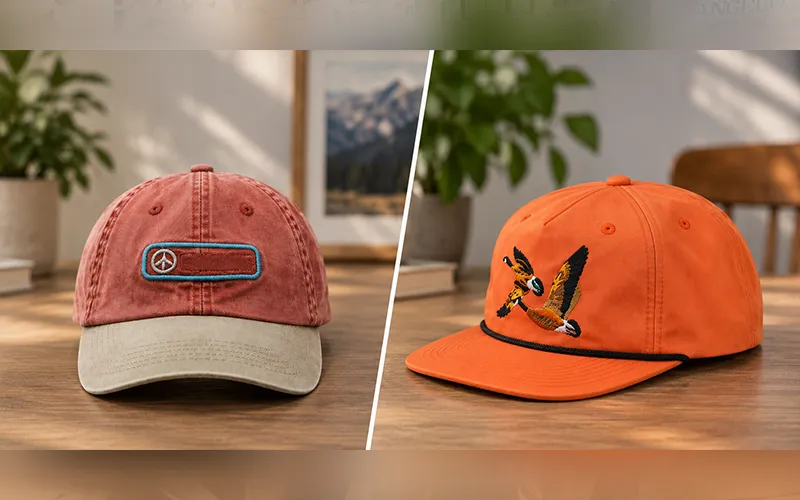
The key difference between 5-panel and 6-panel hats comes from how the crown is constructed. A 5-panel hat typically uses one continuous front panel with no vertical center seam, creating a cleaner and often flatter front. A 6-panel hat features two front sections connected by a center seam, giving it the classic rounded shape often seen in traditional baseball caps. This construction difference also affects fit, crown silhouette, logo placement, and overall style.
Neither construction is inherently better. A 5-panel may be preferable when you want an uninterrupted front surface or a modern silhouette, while a 6-panel is often chosen for its classic, contoured appearance. The best option depends on your preferred look, comfort, fit, and how you plan to wear the hat.
Table of Contents
Toggle5-Panel vs 6-Panel Hats: Comparing the Main Features
| Feature | 5 Panel Hat | 6 Panel Hat |
| Number of Crown Panels | 5 panels | 6 panels |
| Front Construction | One continuous front panel | Two front panels |
| Center Front Seam | Usually no | Yes |
| Crown Shape | Often flatter or boxier | Usually rounder and more contoured |
| Crown Profile | Can be low, medium, or high | Can be low, medium, or high |
| Fit | Often has a more streamlined fit | Often follows the head shape more naturally |
| Front Logo Area | Clean, uninterrupted surface | Divided by a center seam |
| Logo Placement | Good for wide logos, patches, and graphics | Good for compact logos and traditional embroidery |
| Common Styles | Streetwear, skate, outdoor, casual | Baseball, sports, casual, streetwear |
| Brim Options | Flat or curved | Flat or curved |
| Structure | Structured or unstructured | Structured or unstructured |
| Main Advantage | Clean front surface for decoration | Classic and versatile cap silhouette |
One important distinction is that panel count describes how the crown is constructed. It does not automatically determine the brim, closure, crown height, or whether the hat is structured or unstructured. Both constructions can be adapted into different cap styles.
What Is a 5 Panel Hat?
A 5-panel hat is made with five sections of fabric forming the crown. A typical design features one broad front section, two panels along the sides, and another two at the back.
The defining visual feature is the uninterrupted front. Instead of dividing the front into two pieces, the construction uses one continuous panel, eliminating the vertical seam found on most 6-panel caps.
This creates a relatively clean surface and often contributes to the flatter or slightly boxier silhouette associated with many 5-panel hats.
Key Characteristics of a 5 Panel Hat
A typical 5-panel hat has a seamless front panel, a relatively clean crown design, and a broad front area that works particularly well with prominent graphics, patches, and logos.
Many 5-panel styles are associated with streetwear, skate, outdoor, and lifestyle fashion. However, “5-panel” describes the panel construction rather than one fixed style. A 5-panel cap does not necessarily have to be low-profile, flat-brimmed, or unstructured.
Its exact appearance still depends on the crown pattern, material, internal support, visor, and other design choices.
What Is a 6 Panel Hat?
A 6-panel hat is built from six fabric pieces that make up the crown, typically with two sections at the front, two on the sides, and two at the back.
The two front panels meet vertically at the center of the hat, creating the characteristic front seam. Because multiple panels converge around the crown, 6-panel construction commonly produces the rounded, contoured silhouette associated with traditional baseball caps.
Six-panel construction is extremely versatile. It can be found in baseball caps, dad hats, snapbacks, performance caps, sports caps, and many other styles.
Key Characteristics of a 6 Panel Hat
The most recognizable characteristics are the two-piece front, center seam, and generally rounded crown.
However, not every 6-panel hat looks the same. Some hat designs have a firm, structured front, while others feature a softer, more relaxed shape. They can also have low, medium, or high crowns.
This is why the number of panels should not be used alone to predict exactly how a hat will fit.
5 Panel vs 6 Panel Hat: Key Differences Explained
Although the number of panels sounds like a minor construction detail, changing the front crown from one panel to two changes several aspects of the finished hat.
1. Panel Construction
The easiest way to distinguish the two hats is to look directly at the front of the crown.
A typical 5-panel uses:
1 front panel + 2 side panels + 2 back panels
A typical 6-panel uses:
2 front panels + 2 side panels + 2 back panels
The difference is therefore not simply that one hat contains an additional piece of fabric. Where that additional panel is positioned matters.
On the 6-panel, dividing the front into two pieces creates a vertical center seam and helps form its characteristic rounded shape.
2. Front Panel
When placed next to each other, the front design is one of the clearest differences between the two hat styles.
A 5-panel provides one continuous surface across the front. This creates a cleaner visual plane without a seam running through the center.
A 6-panel divides this area into two sections. The resulting center seam becomes part of both the construction and visual appearance of the cap.
This distinction is especially noticeable when the hat carries a large front graphic.
3. Crown Shape and Profile
Many 5-panel hats have a flatter or slightly more angular crown, while many 6-panel hats have a rounder, more contoured appearance.
But this should be understood as a common tendency rather than a fixed rule.
Panel count and crown profile are two different specifications.
A manufacturer can adjust crown depth, panel pattern, fabric stiffness, internal support, and other construction details. As a result, both 5-panel and 6-panel hats can be designed with different crown heights.
So it is inaccurate to assume:
5 panel = always low profile
or:
6 panel = always high profile
When comparing actual products, look at the crown specifications rather than panel count alone.
4. Fit
The construction also influences how the crown sits around the head.
Many 5-panel hats create a flatter front and more distinctive silhouette. Depending on the pattern, they may feel less traditionally contoured around the front of the head.
A 6-panel construction usually follows the rounded shape of the head more closely because its separate crown panels allow the cap to form a dome-like structure.
However, panel count alone cannot tell you whether a hat will fit well.
Actual fit also depends on:
- Crown depth
- Head circumference
- Panel pattern
- Fabric
- Sweatband
- Closure
- Structured or unstructured construction
For this reason, someone choosing between the two should evaluate the actual hat profile and measurements, not simply assume one panel construction is better for a particular head size.
5 Panel vs 6 Panel Hat Logo Placement
One of the most practical differences between the two constructions is the front decoration area.
Logo Placement on a 5 Panel Hat
Because the front panel is continuous, there is no center seam running through the artwork.
This can provide a useful surface for:
- Wide logos
- Large graphics
- Woven patches
- Leather patches
- PVC patches
- Printed artwork
- Front embroidery
The uninterrupted front is particularly useful when a design depends on precise symmetry or contains small details near its center.
Logo Placement on a 6 Panel Hat
A 6-panel hat can also accommodate embroidery, patches, printing, and other decoration methods. The difference is that designers need to account for the vertical seam running through the middle.
Compact logos and traditional embroidered emblems usually work well.
Larger artwork can also be used, but its position, stitch path, and important details should be planned so that the center seam does not negatively affect the finished appearance.
This does not mean 6-panel hats are poor choices for embroidery. They are widely used for embroidered sports, corporate, fashion, and team caps. The difference is simply that the center seam becomes part of the decoration planning process.
5 Panel vs 6 Panel Hat Style
Construction changes the visual personality of the cap even before color, fabric, and decoration are added.
5 Panel Hat Style
Five-panel hats often have a cleaner and more contemporary appearance.
They are commonly associated with:
- Streetwear
- Skate-inspired fashion
- Outdoor lifestyle
- Minimalist designs
- Casual fashion
The broad front panel can make a graphic or patch feel like a more deliberate part of the hat’s overall design.
This makes the style especially recognizable in collections where the hat itself is intended to make a visual statement.
6 Panel Hat Style
Six-panel hats generally have a more traditional appearance because their rounded crown closely resembles the classic baseball-cap silhouette.
They are commonly found in:
- Sportswear
- Team apparel
- Casual fashion
- Workwear
- Streetwear
- Everyday caps
The advantage of the 6-panel is versatility. Its familiar silhouette can move between athletic, casual, workwear, and fashion applications simply by changing the fabric, profile, visor, and decoration.
5 Panel vs 6 Panel Hats for Different Activities
Panel construction can influence appearance and fit, but it should not be confused with performance.
Everyday Wear
Both are suitable for everyday use.
A 5-panel can create a more distinctive, design-focused look, while a 6-panel offers the familiar silhouette most people associate with traditional caps.
Streetwear
Both constructions appear in streetwear.
Five-panel hats are often associated with minimalist, skate, and lifestyle aesthetics because of their uninterrupted front and distinctive crown.
Structured 6-panel snapbacks are also deeply established in streetwear, particularly when a stronger and more traditional crown silhouette is desired.
Sports
Six-panel construction is particularly common in traditional baseball and sports-inspired headwear because of its rounded, familiar cap shape.
That does not mean the sixth panel itself makes the hat perform better.
Performance depends more on material, fit, sweat management, ventilation, and construction quality.
Outdoor Activities
Both 5-panel and 6-panel hats can work well outdoors.
For hiking, running, fishing, travel, or other outdoor activities, pay more attention to features such as:
- Breathable fabric
- Moisture management
- Ventilation
- Lightweight construction
- Sweatband
- UV protection
- Secure fit
A lightweight nylon 5-panel may perform very differently from a heavy cotton 5-panel. The same applies to 6-panel hats.
Therefore, panel count should not be treated as a measure of breathability or outdoor performance.
Which Is More Comfortable: 5 Panel or 6 Panel Hat?
Neither a 5-panel nor a 6-panel hat is automatically more comfortable. Comfort depends more on crown dimensions, head shape, fabric, sweatband, structure, closure, and overall fit.
A person who prefers a flatter crown may find certain 5-panel designs more comfortable. Someone who prefers a crown that follows the natural contour of the head may prefer a 6-panel.
Even two 6-panel hats can feel completely different if one is a shallow unstructured dad hat and the other is a tall structured snapback.
For comfort, evaluate the complete cap construction rather than treating panel count as the deciding factor.
5 Panel vs 6 Panel Hat for Different Head Shapes
There is no universal rule saying a particular head shape must wear a 5-panel or 6-panel hat.
What matters more is how the crown height, depth, width, and silhouette interact with the wearer’s proportions.
People with smaller or narrower heads may prefer a lower or more compact crown because an oversized crown can visually overwhelm the head.
People with larger or rounder heads may find deeper, more contoured crowns comfortable, although this varies considerably between designs.
Likewise, someone with a longer face may prefer to avoid an unnecessarily tall crown, while a more structured profile can add visual height to a rounder face.
The better question is therefore not simply:
“Should I wear a 5-panel or 6-panel?”
Instead, ask:
“Which crown profile and depth fit my head best?”
Panel construction is only one part of that answer.
5 Panel vs 6 Panel Hat for Customization
Both constructions offer extensive customization possibilities, but their front-panel geometry affects how different decoration methods behave.
Embroidery
A 5-panel provides an uninterrupted front area, which can be useful for wide or detailed embroidery.
On a 6-panel, embroidery may cross the center seam. Good digitizing, placement, stabilization, and production control are therefore important, particularly for detailed centered artwork.
Patches
Both constructions work well with:
- Embroidered patches
- Woven patches
- Leather patches
- PVC or rubber patches
For larger rectangular or horizontally oriented patches, the flat uninterrupted area of some 5-panel hats can be particularly convenient.
Printing
Printed artwork can benefit from the continuous front of a 5-panel when the design needs a broad uninterrupted area.
Six-panel hats can also be printed, but artwork crossing the center seam requires additional attention to alignment.
For brands developing custom headwear, panel construction should therefore be considered together with crown profile, fabric, logo size, decoration method, and intended fit rather than selected in isolation.
SUMKCAPS provides custom headwear design, production, wholesale, and customization services, including different 5-panel and 6-panel constructions, materials, crown profiles, colors, visors, and decoration options.
5 Panel vs 6 Panel Hats: How to Choose the Right One
Choosing between them becomes easier when you focus on the finished appearance rather than simply counting panels.
Choose a 5-panel hat if you prefer a clean uninterrupted front, a flatter or more distinctive silhouette, modern streetwear or outdoor aesthetics, or additional flexibility for wide graphics and patches.
Choose a 6-panel hat if you prefer a rounded traditional crown, classic baseball-cap styling, a familiar everyday silhouette, or a versatile shape that works across sports, casual, workwear, and streetwear applications.
Neither option is objectively superior.
When appearance matters most, compare the crown silhouettes. For a better fit, look at the actual crown dimensions. Customization also matters, so check how your artwork will fit across the front panel and center seam.
Conclusion
The fundamental difference between 5-panel and 6-panel hats is how the front of the crown is constructed. A typical 5-panel uses one continuous front panel without a vertical center seam, while a 6-panel uses two front panels joined in the middle. This generally gives the 5-panel a cleaner, flatter front and the 6-panel a rounder, more traditional cap silhouette.
But panel count is only one part of hat design. It does not independently determine brim shape, closure, crown height, comfort, breathability, or whether a cap is structured.
For most buyers and wearers, the better way to choose is to consider crown shape, fit, style, logo placement, and intended use together. If those factors match your needs, either a 5-panel or 6-panel hat can be the right choice.
FAQ
5-Panel vs 6-Panel Hats: What Makes Them Different?
A 5-panel typically has one continuous front panel, while a 6-panel has two front panels separated by a center seam. This usually gives them different crown shapes.
Which Hat Offers More Benefits: 5-Panel or 6-Panel?
Neither is universally better. A 5-panel offers a cleaner front surface, while a 6-panel provides a more traditional rounded cap shape. Choose based on fit, style, and intended use.
Are 5 panel hats good for small heads?
They can be, particularly when designed with a lower or shallower crown. However, panel count alone does not determine fit, so check the actual crown dimensions.
Why do 6 panel hats have a seam in the front?
A 6-panel crown uses two separate front panels. Where these panels are sewn together, they create the vertical center seam characteristic of the construction.
Are baseball caps 5 panel or 6 panel?
Traditional baseball caps are commonly 6-panel, but baseball-style caps can use other constructions. “Baseball cap” describes a broader style, while panel count describes crown construction.
Tags