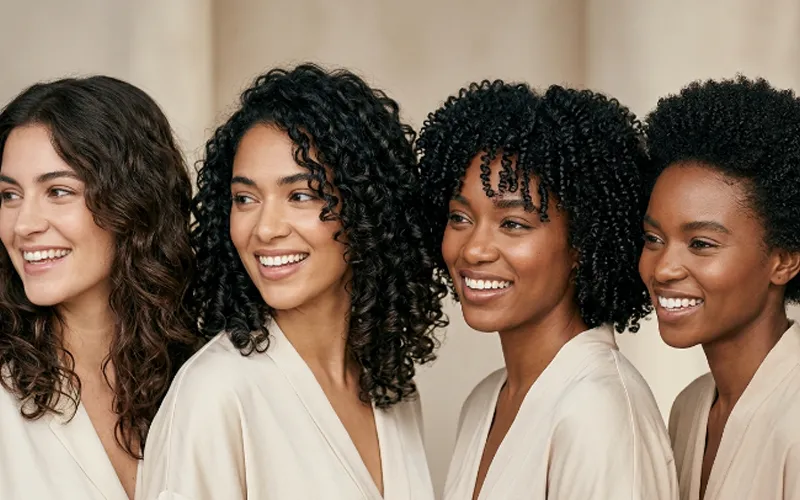
Curly hair can look very different from one person to another. Some people have soft waves that barely form a curl, while others have large, loose curls or small, tight coils. This is why understanding curly hair types can make hair care much easier. Your natural pattern can affect how much moisture your hair needs, how often you should wash it, which products may work well, and even which hairstyles are easier to manage.
Many people try to identify their hair type by looking at pictures online, but it is not always that simple. Hair can have more than one pattern, and the same person may have loose curls in one area and tighter curls in another. Hair length, damage, humidity, products, and styling habits can also change how the pattern looks. Learning about different curly hair types gives you a better starting point for understanding your own hair without trying to force it into one exact category.
What Are the Curly Hair Types?
The common hair typing system divides natural hair patterns into four main groups: Type 1, Type 2, Type 3, and Type 4. Type 1 is straight hair, while Type 2 is wavy hair, Type 3 is curly hair, and Type 4 is coily or tightly curled hair. Each main group has smaller categories, usually marked with letters A, B, and C.
When people search for what are the curly hair types, they are often looking for the Type 2, Type 3, and Type 4 patterns. However, hair typing is not a perfect science. It is simply a useful way to describe the shape of your natural hair. Your hair can also have more than one pattern at the same time.
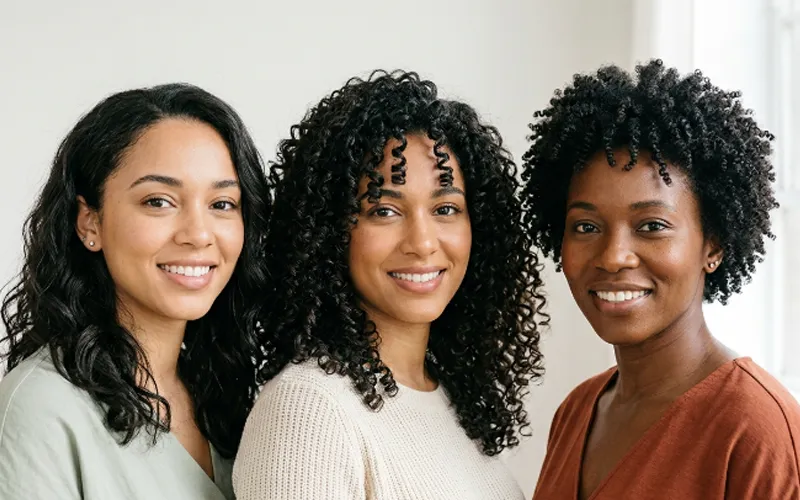
For example, the hair around your face may form large curls while the hair at the back forms smaller curls. This is completely normal. Instead of worrying about finding one perfect label, it is more useful to understand how your hair behaves and what it needs.
curly hair types
Type 2 Hair and Its Wavy Patterns
Type 2 hair sits between straight and curly hair. It usually has a wave shape rather than a complete spiral. Some Type 2 hair looks almost straight near the roots and becomes more wavy toward the ends. Other hair in this group has strong waves that can look similar to loose curls.
Type 2A is usually very light and soft. The hair may have a gentle wave and can sometimes become straight with brushing or styling. Type 2B has stronger waves that are easier to see. Type 2C has the strongest wave pattern and may form loose curls in some areas.
This is why wavy curly hair types can sometimes be confusing. Type 2C, in particular, may look curly even though it is classified as wavy hair. The difference is mainly in the shape of the pattern rather than simply how much volume the hair has.
Type 3 Hair and Defined Curls
Type 3 hair is what many people usually imagine when they hear the word curly. It forms visible curls that may look like loops, spirals, or springs. The curls can be large and loose or smaller and tighter depending on the category.
Type 3A usually has large, loose curls. These curls may look soft and have a clear spiral shape. Type 3B generally has tighter curls with more volume and bounce. Type 3C has small, tight curls that are usually more compact and can create a lot of volume.
People with Type 3 hair often notice that their curl pattern changes depending on moisture and styling. When the hair is dry or damaged, curls may look less defined. With good moisture and gentle styling, the natural pattern can become much easier to see.

curly hair types
Type 4 Hair and Tight Coils
Type 4 hair is often described as coily or tightly curled. The pattern can be very small and compact, and the hair may have significant shrinkage when it dries. Shrinkage means the hair looks shorter after it returns to its natural shape.
Type 4A usually has small, clearly visible curls. With Type 4B hair, the curl shape is less obvious and may form a zigzag or bent pattern. In comparison, Type 4C has the tightest pattern, with very small bends and coils that can be difficult to see without looking closely.
These patterns can be beautiful and highly versatile, but they may need careful handling. The bends in tightly curled hair can make it easier for the hair to become dry or break when it is handled roughly. Gentle washing, moisturizing, detangling, and styling can help protect the strands.
How to Find Your Natural Pattern
Finding your pattern is easier when you look at your hair in its natural state. Start by washing your hair gently and allowing it to dry without heavy styling products. Avoid straightening, curling irons, or other heat tools before checking the pattern.
Once your hair is dry, look at several areas instead of checking only one section. Notice whether your hair forms waves, loose spirals, tight curls, or small coils. Compare the shape of several strands and sections because your entire head may not have the same pattern.
It is also useful to check your hair when it is not weighed down by oils, heavy creams, or styling products. Some products can stretch the curl pattern and make your hair appear less curly than it naturally is.

curly hair types
Curl Pattern and Hair Porosity Are Different
One common mistake is thinking that curl type tells you everything about your hair. It does not. Curl pattern describes the shape of the hair, while porosity describes how easily your hair takes in and holds moisture.
Two people can have the same curl pattern but completely different hair needs. One person may have fine hair that becomes oily quickly, while another may have thick hair that needs more moisture. Hair porosity, strand thickness, density, and overall condition can all affect your routine.
For this reason, curl pattern curly hair types should be considered only one part of understanding your hair. A good routine should be based on how your hair actually behaves rather than its label alone.
Curly Hair Types for Men
Hair type is not determined by gender. Curly hair types men have are the same basic patterns found in women. Men can have wavy, curly, or tightly coiled hair, and their hair can also contain more than one pattern.
The main difference is often the haircut and length. Short curly hair may not show its full curl pattern because the weight and length needed to form a complete curl are missing. As the hair grows, the natural shape may become much easier to see.
Curly hair types for men can include everything from loose Type 2 waves to Type 3 curls and Type 4 coils. The best routine depends more on the condition and behavior of the hair than on whether the person is male or female.
Curly Hair Types for Women
Curly hair types women have can range from soft waves to very tight coils. Like men, women can also have several curl patterns on the same head. Hair length, layers, coloring, heat styling, and products can change the way the pattern looks.
Women with longer curly hair may notice that some curls become looser because the weight of the hair pulls them down. Shorter hair may appear curlier because there is less weight holding the strands down.
This means the same person’s pattern can appear different after a haircut. It is better to focus on the natural shape of the strands rather than relying completely on a single picture or category.
Curly Hair Types for Boys
Children can also have different natural curl patterns. Curly hair types boys may have can include loose waves, large curls, small curls, or tight coils. A child’s hair may also change as they grow because hair texture and density can change over time.
Parents do not need a complicated routine to care for a child’s curls. Gentle washing, suitable conditioning, careful detangling, and avoiding rough brushing can help keep the hair comfortable and manageable.
For children, it is usually more useful to focus on healthy hair habits than on giving the hair a strict type label. The natural pattern can become easier to understand as the child gets older.
How Hair Products Affect Your Curl Pattern
Hair products can make your curls look very different. A lightweight product may allow waves and curls to stay soft and loose, while a stronger styling product may create more definition and hold.
Heavy products can sometimes make fine waves look flat. On the other hand, people with dry, tightly curled hair may find richer products useful for adding moisture and reducing dryness.
You do not need to buy products simply because they are advertised for a specific curl category. Read the product information and consider your own hair’s needs. A product that works well for one person with 3A curls may not work the same way for another person with the same category.
How Washing Can Change the Appearance of Curls
The way you wash your hair can affect how your natural pattern appears. Harsh cleansing or washing too frequently may leave some curly hair feeling dry. Very heavy buildup, however, can make hair feel coated and prevent curls from looking fresh.
After washing, many people find that gently squeezing excess water from the hair helps preserve the natural shape. Rough towel drying can disturb the curl pattern and create extra frizz.
The important thing is to observe your own hair. If your curls look better after one washing routine than another, that information is more useful than following a general rule based only on your hair type.
Why Curly Hair Can Look Frizzy
Frizz is common across many different curly hair types. It can happen when individual strands do not stay grouped together with the rest of the curl. Humidity, dryness, friction, damage, and rough handling can all contribute to a frizzy appearance.
Some frizz is completely normal. Curly hair does not have to look perfectly smooth to be healthy. Trying to remove every single flyaway can sometimes lead to excessive brushing or heat styling, which may cause more problems over time.
A gentle routine can help curls stay together and look more defined. However, the goal should be manageable, healthy-looking hair rather than perfect curls every day.
How to Protect Your Natural Pattern
Protecting curly hair starts with gentle handling. Avoid pulling or brushing the hair aggressively, especially when it is dry. Detangling with care can reduce unnecessary breakage and help maintain the shape of the curls.
It can also help to avoid using high heat too often. Excessive heat may change the appearance of curls and can cause damage when used repeatedly. If heat styling is part of your routine, using suitable protection and keeping the heat under control can reduce some risks.
Your sleeping habits can also affect your curls. Friction against a rough pillowcase may disturb the curl shape and increase frizz. Some people find that smoother fabrics or a loose protective hairstyle help their curls look better the next day.
Curly Hair Types Chart for Men and Women
A curly hair types chart men and women can use is mainly a simple visual guide. Type 2 includes wavy patterns, Type 3 includes clear curls, and Type 4 includes tighter curls and coils. The A, B, and C categories then describe differences within those groups.
A chart can make it easier to compare your hair with general examples, but it should not become a strict rule. Real hair can sit between categories, and different parts of the same head can show different patterns.
The best way to use a chart is to combine the visual information with your own observations. Look at your natural hair after washing, consider how it behaves without heavy products, and check several sections before choosing a category.
Common Mistakes When Identifying Your Hair
One common mistake is identifying the hair while it is wet. Wet hair often looks longer and more stretched than it does when dry. This can make curls appear looser than their natural pattern.
Another mistake is checking only the front section. The hair around your face may have a different pattern from the hair at the crown or back of your head. Looking at several areas gives you a more realistic picture.
People also sometimes confuse volume with curl tightness. Hair can be very full without having tight curls, while tightly curled hair can look less voluminous when it is weighed down by products. Focus on the actual shape of the strands rather than the amount of hair you see.
Does Your Curl Type Stay the Same Forever?
Your natural pattern can change in appearance over time. Hair growth, age, hormonal changes, chemical treatments, heat damage, coloring, and styling habits may all affect how your curls behave.
Damage can make some sections look straighter or less defined. After damaged hair grows out and healthier hair appears, the natural pattern may become more visible again.
This is another reason not to become too focused on one number or letter. The category is useful for communication, but the health and behavior of your hair matter more when building a daily routine.
Final Thoughts
Understanding curly hair types can make it easier to learn about your natural texture and choose a routine that fits your hair. The main groups range from wavy Type 2 patterns to curly Type 3 patterns and tightly curled or coily Type 4 patterns. Within these groups, the A, B, and C categories describe different levels of pattern definition and tightness.
A curly hair types chart can be useful when you are learning the basics, but you should not feel pressured to match your hair perfectly to one category. Your hair may contain different curly hair types, and its appearance can change with length, moisture, products, damage, and styling.
Whether you are looking at curly hair types men, curly hair types women, curly hair types male, or curly hair types boys, the basic idea remains the same. Look at your natural hair carefully, understand its behavior, and build your routine around what it actually needs. Your curl pattern is simply a helpful starting point for better hair care.
Frequently Asked Questions
- What are the different curly hair types?
The main curly hair types are divided into Type 2, Type 3, and Type 4. Type 2 is usually wavy, Type 3 has clear curls, and Type 4 includes tight curls and coils. Each group is further divided into A, B, and C patterns.
- How do I know what curly hair type I have?
Wash your hair and let it dry naturally without heavy styling products. Then look at the shape of your waves, curls, or coils in different areas. Comparing your natural pattern with a curly hair types chart can help you identify the closest category.
- What is the difference between 2A, 2B, and 2C hair?
The main difference is the strength of the wave. Type 2A has very soft waves, Type 2B has more visible waves, and Type 2C has stronger waves that can look close to loose curls.
- What is the difference between 3A, 3B, and 3C curls?
Large and loose curls are common with Type 3A hair, while 3B usually has tighter and more defined curls. Smaller and tighter curls are typical of Type 3C hair, often creating more volume and a compact curl pattern.
- Can I have more than one curly hair type?
Yes. It is common to have more than one curl pattern on the same head. For example, one area may have loose 3A curls while another area has tighter 3B or 3C curls.
- Are curly hair types different for men and women?
No. Men and women can have the same curl patterns, including Type 2, Type 3, and Type 4. Hair length, haircut, density, and styling can make the curls look different, but the basic curl classification is the same.
- What are the 4 main curly hair types?
The four main hair categories are Type 1, Type 2, Type 3, and Type 4. Type 1 is straight, Type 2 is wavy, Type 3 is curly, and Type 4 is coily or tightly curled. The curly categories most people focus on are Types 2, 3, and 4.
- Can curly hair change its curl pattern over time?
Yes. Hair length, heat styling, chemical treatments, coloring, damage, products, and changes in hair condition can affect how the curl pattern looks. Your natural pattern may also appear different as your hair grows or becomes healthier.