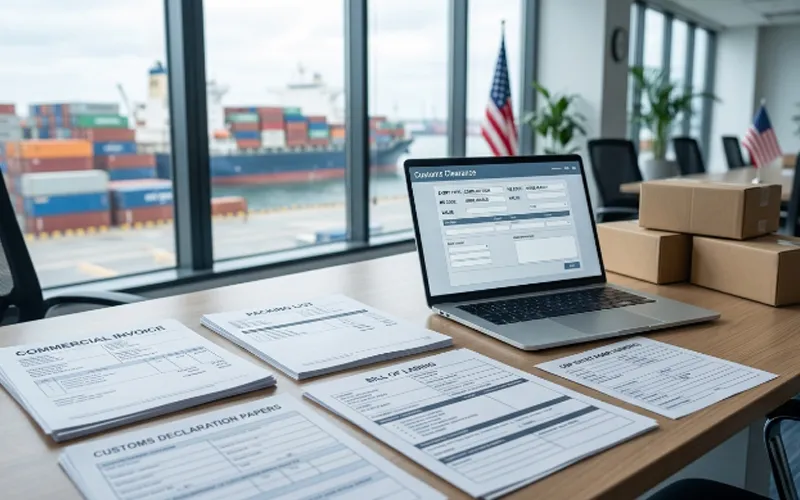
Documents Required for US Customs Clearance: The Complete List
US customs clearance runs on a fixed document set. Most commercial shipments require a commercial invoice and transport documentation, while a packing list is commonly used to support the customs entry. Your customs broker converts those into the entry itself: CBP Form 3461 for release and CBP Form 7501 for the entry summary, filed electronically in ACE and backed by a customs bond on formal entries. Ocean cargo adds an Importer Security Filing before the vessel loads, and regulated products add partner government agency documents on top. Since the de minimis exemption was suspended, low-value shipments may also require customs entry documentation, although specific requirements vary by shipment type, value, and commodity.
Table of Contents
ToggleEvery US Import Now Requires Entry Documentation
Import shipments may now require customs entry documentation even when their value is relatively low. CBP suspended the Section 321 de minimis exemption for China and Hong Kong on May 2, 2025, extended the suspension to all origins on August 29, 2025, and codified it indefinitely through two interim final rules published on June 24, 2026. The release from manifest process disappeared with it, and ACE stopped accepting Entry Type 86 filings. The statutory repeal of de minimis takes effect on July 1, 2027, so this is the permanent state of play.
What replaces it is a two-track document regime. Shipments valued at $2,500 or less generally qualify for informal entry treatment, subject to applicable exceptions and regulatory requirements. Shipments above $2,500 generally require formal entry procedures, while certain regulated or otherwise restricted goods may require formal entry regardless of value. For shipments at or below $2,500, additional requirements may still apply when the goods are subject to partner government agency regulations, quotas, or antidumping and countervailing duties. Our guide to US customs entry types explains how the two tracks differ in practice.
The Commercial Invoice Drives the Entire Entry
The commercial invoice is the master document. CBP regulation 19 CFR 141.86 sets its required contents: the names of the seller and buyer, an adequate description of the merchandise in English, quantities in standard units, the unit price and total value in the currency of the transaction, the country of origin, the terms of sale, any discounts or rebates, and the invoice date. The port of entry and identifying marks and numbers on the packages round out the list.
Description quality decides classification quality. A line reading ‘auto parts’ forces your broker to guess at the 10-digit HTS code; a line reading ‘aluminum brake calipers for passenger vehicles’ supports a defensible classification, and in 2026 the classification also determines which Chapter 99 tariff layers attach to the line. If the commercial invoice is unavailable at the time of entry, 19 CFR 141.85 allows a pro forma invoice as a stopgap, but the importer must produce the real invoice afterward, so treat the pro forma as an exception rather than a workflow.
The Packing List Verifies What the Invoice Claims
The packing list breaks the shipment down to the carton level: contents, piece counts, net and gross weights, and dimensions for each package. CBP officers use it to reconcile the physical freight against the invoice during examinations. It carries no values, which is exactly why it works as a verification instrument. Mismatches between the packing list and the invoice are one of the most common triggers for a customs hold, so the two documents must agree line for line before the shipment moves.
The Bill of Lading or Air Waybill Proves the Right to Make Entry
The transport document does two jobs. Commercially, the ocean bill of lading or air waybill is the contract of carriage. At the border, it is the evidence of the right to make entry under 19 CFR 141.11: CBP releases goods only to a party who can show they own, have purchased, or hold a properly endorsed bill for the freight. Ocean shipments may move on an original bill that must be surrendered, or on an express or telex-released bill that clears without paper. The carrier’s arrival notice, issued as the shipment approaches the port, ties the transport document to a specific vessel, flight, and arrival date and tells your broker the clock has started.
CBP Forms 3461 and 7501 Are the Entry Itself
Everything above feeds two filings that your broker transmits through ACE. CBP Form 3461, the entry and immediate delivery filing, requests release of the goods and is what customs conditionally approves when your shipment clears. CBP Form 7501, the entry summary, follows within 10 working days of release and is the legal declaration of classification, valuation, origin, and duty. Every tariff program that applies to your goods appears on the 7501 as an additional Chapter 99 classification alongside the product’s own 10-digit code, which is why one product line can carry several tariff lines in 2026. The entry then sits open until CBP liquidates it, finalizing the duties owed.
A Customs Bond Backs Every Formal Entry
Formal entries require a customs bond, the financial guarantee that duties, taxes, and fees will be paid. Importers choose between a single transaction bond covering one entry and a continuous bond covering all entries for a year, with the continuous bond starting at a $50,000 limit. Frequent importers almost always come out ahead on a continuous bond. Two 2026 realities are worth flagging. First, stacked tariffs have pushed many importers’ duty liability past their bond limits, and CBP issues insufficiency notices when that happens, so bond sizing needs an annual review. Second, even the new postal informal entry process created in June 2026 requires a basic importation and entry bond, extending bond obligations into channels that never needed them before.
The Importer Security Filing Precedes Ocean Cargo
Ocean freight adds a document that must exist before the ship is even loaded. The Importer Security Filing, commonly called ISF or 10+2, transmits ten data elements about the buyer, seller, manufacturer, and cargo to CBP at least 24 hours before the container is laden at the foreign port. It is a security filing rather than an entry document, but it belongs on this checklist because a late, inaccurate, or missing ISF carries penalties of $5,000 per violation and invites holds and exams on arrival. Air, truck, and rail shipments have no ISF requirement.
The Power of Attorney and Importer Number Establish Who Enters the Goods
Before a broker can file anything on your behalf, two identity documents must be in place. The importer identity form, CBP Form 5106, registers your business with CBP under its employer identification number, or a Social Security number for sole proprietors, and creates the importer of record account that every entry references. The customs power of attorney then authorizes the broker to transact customs business in your name. First-time importers should complete both before the freight ships, because neither can be backfilled while cargo sits at the port accruing storage.
Certificates of Origin Support Duty Claims
Origin documentation earns its place in the file twice over. For preference claims, the USMCA certification of origin has no prescribed form; it is a set of nine minimum data elements, covering the certifier, the goods, the origin criterion, and the blanket period, that can sit on the invoice or a separate document and must be in hand before a claim is made. Other free trade agreements carry their own certification rules. Beyond preference, origin now determines exposure: whether Section 301 applies, whether a Section 232 program reaches the goods, and what the country of origin marking must show. Importers claiming the melt-and-pour or smelt-and-cast US-content relief under the 2026 Section 232 adjustments need mill and production documentation to support the claim, and CBSA-style assumptions do not exist here; CBP expects the importer to hold the proof.
Partner Government Agency Documents Apply to Regulated Goods
Where another federal agency regulates your product, its documents ride along with the customs entry and are transmitted through the same ACE filing. The most common sets:
- FDA: prior notice for food shipments, filed and confirmed before arrival, with deadlines that run from two hours for road freight up to eight hours for ocean, plus Foreign Supplier Verification Program obligations resting on the importer
- USDA and APHIS: import permits and phytosanitary certificates for plant and animal products, and the Lacey Act declaration for wood and plant materials
- EPA: TSCA certification for chemical substances and EPA Form 3520-1 for vehicles and engines
- CPSC: a certificate of compliance for consumer products subject to safety rules, including a children’s product certificate where applicable
- FCC: equipment authorization records for radio frequency devices
Forced labor enforcement adds a contingent document set: shipments detained under UFLPA are released only on supply chain tracing documentation running from raw material to finished goods, so importers in exposed categories should assemble that file before shipping, not after detention. For food specifically, FDA’s prior notice requirements for imported food are the controlling guidance, and a shipment without a confirmed prior notice can be refused at the port.
Recordkeeping Closes the Documentation Cycle
Clearance does not end the document obligations. Under 19 CFR Part 163, importers must keep entry records for five years from the date of entry, including the invoice, packing list, transport documents, entry forms, and anything supporting a preference or relief claim. CBP audits against this file, and the most expensive documentation failures are also the most preventable: vague descriptions, values that disagree between invoice and entry, missing or inconsistent origin statements, and consignee details that do not match the importer of record. Each one is a hold, an exam, or a penalty waiting to happen.
A complete, consistent document set is the difference between a shipment that clears on arrival and one that sits. Clearit’s self-serve platform walks you through exactly which documents your shipment needs, collects them digitally, and files the entry with CBP, so your freight clears without the paper chase.
FAQ
What documents do I need to clear US customs?
Every commercial shipment needs a commercial invoice, packing list, and bill of lading or air waybill. Your broker files CBP Form 3461 for release and Form 7501 as the entry summary, backed by a customs bond on formal entries. Ocean cargo requires an ISF before loading, and regulated goods add agency documents.
What is the difference between CBP Form 3461 and Form 7501?
Form 3461 is the release request that lets CBP clear your goods at arrival. Form 7501 is the entry summary filed within 10 working days afterward, declaring classification, value, origin, and duties. The 3461 moves the freight; the 7501 is the legal declaration the entry is judged on.
Do low-value shipments still need customs documents in 2026?
Yes. The de minimis exemption is suspended indefinitely under rules codified in June 2026, ahead of its statutory repeal on July 1, 2027. Shipments of $2,500 or less clear as informal entries with invoice and transport documents; higher values and regulated goods require full formal entry documentation.
Do I need a customs broker to file entry documents?
Importers may self-file, but entries must be transmitted through ACE, and classification, valuation, and tariff declarations carry legal liability under informed compliance. Most importers use a licensed broker under a customs power of attorney, which shifts the filing work to a professional while the importer of record retains responsibility.
How long must import records be kept?
Five years from the date of entry under 19 CFR Part 163. That covers the commercial invoice, packing list, transport documents, entry forms, and all supporting documentation for preference claims or tariff relief. CBP can demand production during audits, and missing records carry penalties independent of any duty owed.
Tags