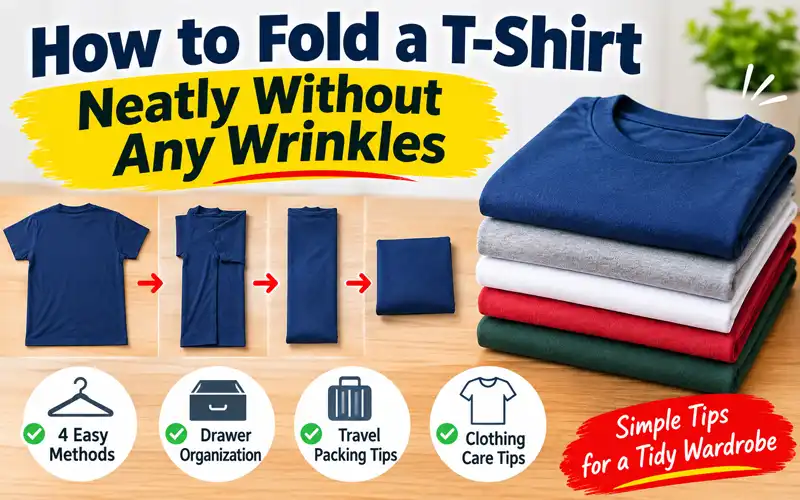
A neatly folded t-shirt looks good, feels good, and saves you from ironing every morning. Still, most of us toss shirts into a drawer and then wonder why they come out creased and crumpled. The good news is that a clean fold takes less than a minute once you know the pattern.
In this guide, you will learn how to fold a t-shirt neatly using four simple methods. You will also find tips for drawers, travel, collared shirts, long sleeves, and keeping your whole wardrobe organized. Pick the method that fits your day, and your closet will stay tidy for good.
Quick Answer in Five Steps
Here is the short version.
- Lay the shirt face down on a flat surface.
- Fold one side toward the center.
- Fold the other side the same way.
- Bring the bottom hem up to the collar.
- Flip the shirt over.
Set Up a Clean Folding Spot
Good folds start before you touch the shirt. Pick a firm, flat surface such as a table, kitchen counter, or desk. A bed feels convenient, but the soft mattress makes the fabric sink and shift, so your folds end up uneven. Wipe the surface and clear enough room to spread the shirt fully open.
Lay the shirt face down so the back is facing you. Pull the hem straight, stretch each sleeve out to the side, and run your palm from the collar down to the hem. This one pass removes small bumps and gives you a clean base.
Take about ten seconds here. It saves more time than it costs, because every fold that follows stays sharp instead of needing a redo.
Classic Store Style Fold
This is the most reliable method, and it works for almost any plain tee. With the shirt face down, take one side and fold it inward so the crease runs from the middle of the shoulder straight down to the hem. The sleeve folds over with it. Press the fold with your hand so the edge is sharp.
Repeat on the other side. You now have a long rectangle with both sleeves tucked inside. The width should be roughly a third of the shirt, which keeps stacks stable and neat. If a sleeve sticks out, tuck it in before moving on.
Finish by bringing the bottom hem up until it nearly touches the collar line, then flip the shirt over. The front now faces up, the collar sits cleanly on top, and the shirt looks like it came off a shop shelf.
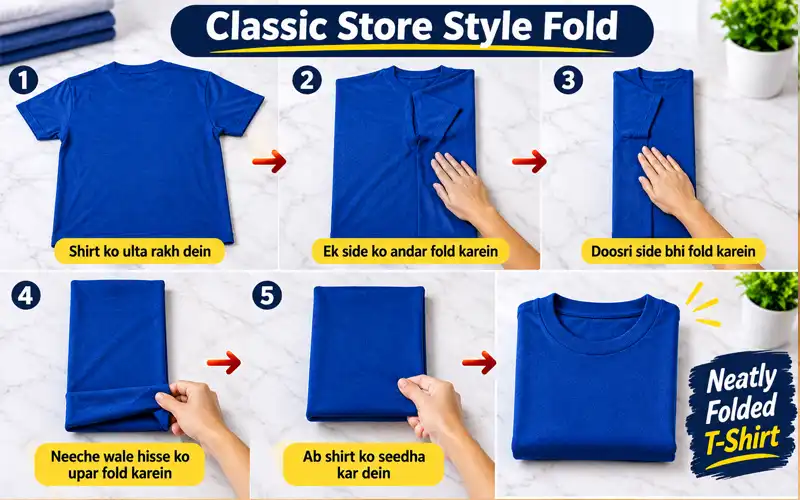
Learn how to fold a T-shirt neatly in simple steps using the classic store style method.
Speedy Pinch Method in Seconds
When you have a full basket to get through, this trick lets you fold t-shirts quickly in one smooth swoop. It feels odd for the first few tries, but your hands learn it fast. Lay the shirt face up. With your right hand, pinch the left side of the shirt a few inches below the shoulder seam, near the collar. With your left hand, pinch the same edge halfway down the body.
Now cross your arms so the top pinch travels down to meet the bottom hem, and hold both points in one hand. Lift the shirt and pull your arms apart. The fabric falls into a neat rectangle with one sleeve dangling. Lay it down and tuck that last sleeve underneath.
The trick works best on medium weight cotton. If your fingers slip on slippery fabric, switch to the classic fold for that shirt.
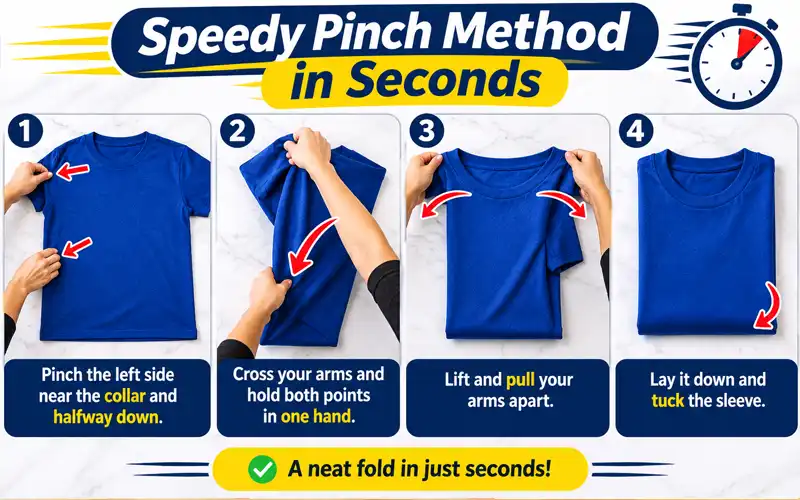
Learn the speedy pinch method to fold T-shirts quickly in four simple steps.
Japanese Folding Method Explained
The Japanese t-shirt folding method is built around one goal, a compact shirt that holds its shape on its own. It became popular through the KonMari tidying approach of Marie Kondo. Start with the same two side folds used in the classic method, so you have a long, narrow rectangle with the sleeves tucked in.
Next, fold the shirt in half from the bottom, then fold again until you have a small, firm block. For shorter shirts, thirds work better. The finished piece should be firm enough to rest on its edge without flopping over. Keep the neckline or a favorite print facing the top so you can spot each shirt at a glance.
People like this method because the fabric is folded into soft, even layers instead of one hard crease across the chest.
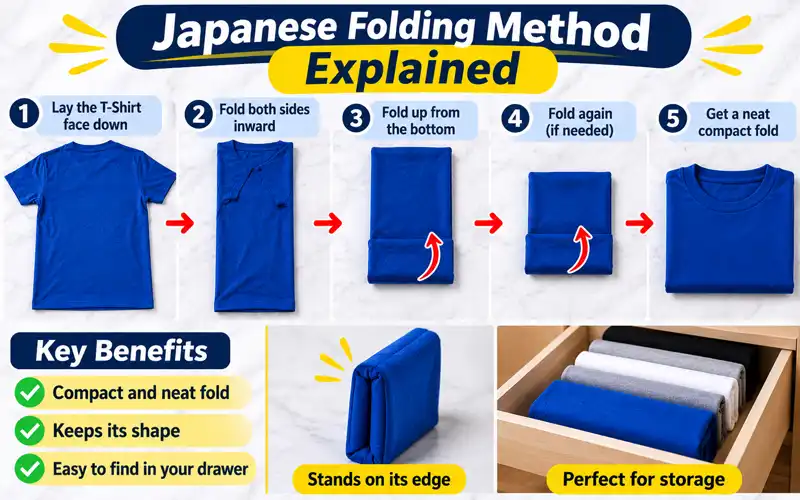
Learn the Japanese T-shirt folding method to create neat, compact folds that stand upright in your drawer.
Army Way With a Paper Guide
Soldiers in basic training learn to keep their kit sharp, and the army way of folding a shirt gives you identical rectangles every time. All you need is an A4 sheet of paper or a piece of card. Lay the shirt face down and place the paper in portrait position just below the collar seam, with its top edge level with the seam.
Fold one side of the shirt over the long edge of the paper. Then fold that sleeve diagonally so it lies flat against the edge, with the sleeve end pointing toward the hem. Do the same on the other side. Fold about two inches of the bottom hem upward, then fold the rest up to the collar. Flip the shirt over and slide the paper out from the top.
This method suits anyone who wants every shirt to be exactly the same size, such as people living in hostels, using lockers, or packing uniform kits.
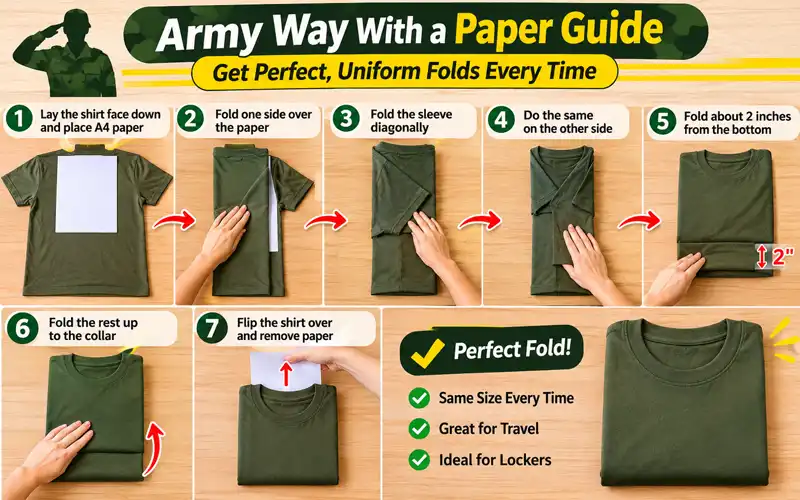
Learn how to fold T-shirts evenly using a simple A4 paper guide in seven easy steps.
Handling Shirts With a Collar
Polo shirts and button shirts need extra care because a crushed collar is hard to fix. If you are wondering how to fold a shirt with a collar, start by buttoning the top button and the one in the middle so the front stays lined up. Lay the shirt face down and flatten the collar by hand, making sure the points are not folded under. If your shirt has metal collar stays, slide them out first so they do not bend.
Fold the sides in as you would for the classic fold, but stop the final upward fold a few inches below the collar so the collar never bends. A strip of thin cardboard inside the collar band keeps it firm if the shirt will be stored for a long time.
Keep collared shirts at the top of a stack so nothing presses on the collar.
Drawer Filing to Save Space
A folded shirt only helps if it fits your drawer well. Instead of piling shirts flat, stand them in rows from front to back, the way files sit in a cabinet. You can see every shirt at once and pull one out without disturbing the rest. This is the best way to fold t-shirts for drawers when space is tight, and it saves a surprising amount of room.
Put everyday tees in the front row and special ones at the back. Leave a little breathing room, roughly a finger’s width at the end of each row, so shirts do not lean into each other. Small boxes or drawer dividers keep the rows from sliding together.
Avoid stuffing the drawer to the brim. A bit of free space helps you put shirts back quickly, and it keeps the whole drawer looking neat for longer.
Packing Shirts for Trips
For wrinkle free travel, fold each shirt using the classic method, then lay the folded shirts flat in a single layer along the bottom of the suitcase. Heavy items such as shoes go beside them, not on top. A sheet of tissue paper between two shirts reduces friction and keeps the surface smooth.
If space is the bigger problem, roll instead. Fold the sides in, then roll from the hem up tightly and place the rolls side by side. Rolled shirts take less room, and when packed firmly they hold their shape. Packing cubes keep everything compact and stop shirts from shifting during the journey.
Unpack soon after you arrive so the shirts do not stay pressed for days.
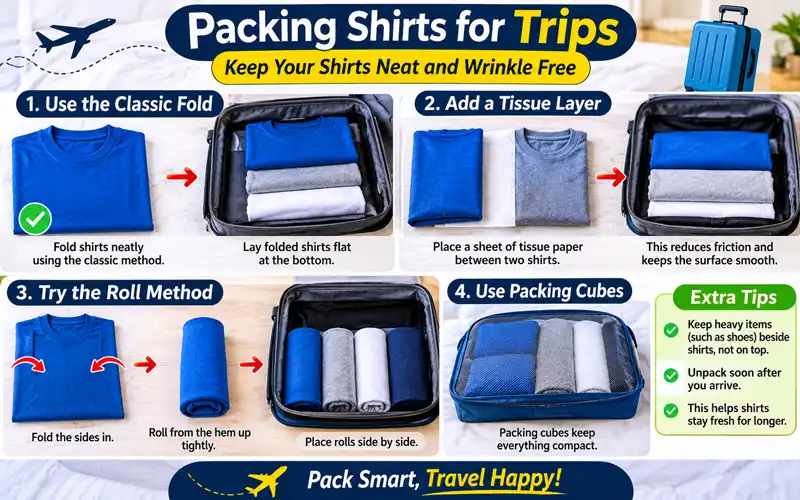
Discover easy ways to pack T-shirts for travel using folding, rolling, tissue paper, and packing cubes.
Adjusting for Oversized and Long Sleeves
Not every shirt behaves like a standard tee. Oversized shirts have extra width, so fold the sides in a little further, then bring the bottom up twice. That reduces the block to a normal size that stacks well with your other shirts.
Long sleeve shirts need the sleeves folded across the back first, either straight across or diagonally, before the side folds. Kids’ shirts are small and light, so a single fold in half after the side folds is plenty.
Cropped and slim fit tees are short, so skip the final upward fold or make it a small one. Folding them in thirds from the sides alone gives a neat square that matches the rest of the pile.
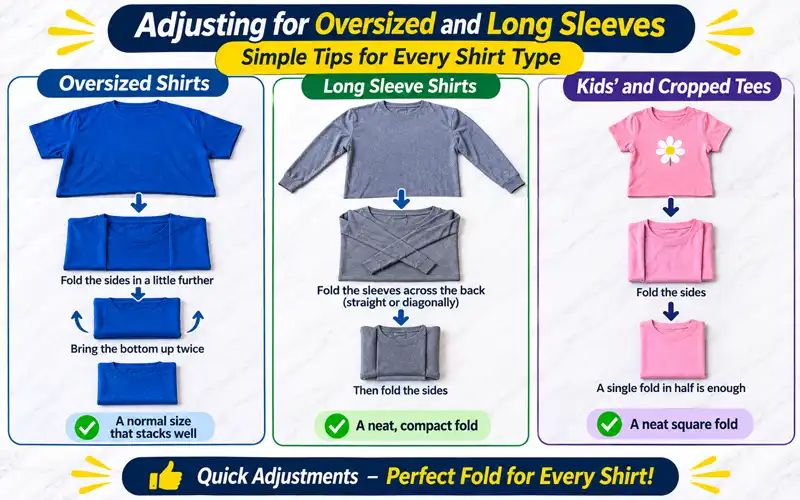
Learn simple folding techniques for oversized shirts, long sleeve tops, and kids’ T-shirts.
Common Slip-Ups That Cause Creases
Most wrinkles come from small mistakes, not from the method itself. Uneven edges are the first culprit. If one side is longer than the other, the whole block twists and creates diagonal lines. Take a moment to line up the hem and the shoulder seams before each fold.
The second mistake is pulling the shirt by the collar. That stretches the neckline and leaves a wavy edge. Hold the shirt by the body or the sleeve instead.
The last mistake is pressing too hard. A firm squeeze on thick fabric leaves sharp lines, while a gentle pat is enough to set the fold.
Tips From Dryer to Shelf
Wrinkle control starts in the dryer. Use a medium or low heat setting and take shirts out as soon as the cycle ends, since a tee left in a cooling drum collapses into creases. Shake each shirt once before folding to release trapped folds. Folding while the fabric is still slightly warm lets it relax under your hands.
Fabric matters too. Cotton wrinkles easily, while polyester and blends bounce back better. For a stubborn crease, lightly mist the area with water and smooth it by hand, or hang the shirt in a steamy bathroom for a few minutes before folding.
If you air dry, wait until the shirt is completely dry before folding. Folding a damp shirt traps moisture and sets creases into the fabric.
Keeping Favorite Tees Looking Fresh
A well-fitting tee loses its charm if the colour fades or the neckline stretches. Wash shirts inside out in cool water, and let them air dry when you can. Store them away from direct sunlight, which bleaches dark colours faster than you might think.
For graphic tees, fold them so the print faces inward. This stops the ink from rubbing against the neighbouring shirt. Keep whites and darks in separate stacks, since lint and dye can transfer between them. Rotate your tees now and then so the one at the bottom of the stack gets a turn.
A crisp neckline and an even hem make a plain white tee look as sharp as a much pricier piece. Good care is what gives a simple shirt its polished look.
Labeling and Sorting by Season
Folding is only half the job. How you sort the folded shirts decides whether the tidiness lasts. Give each drawer or shelf one purpose, such as short sleeve tees in one place, long sleeve tees in another, and gym or sleep shirts in their own spot. A small label on the drawer front helps everyone in the house put things back where they belong.
Twice a year, move off-season shirts to a top shelf or an under-bed box. This keeps your daily drawer light and easy to browse.
While you do the swap, set aside any shirt you have not worn in a year and donate it. Fewer shirts mean looser drawers, and loose drawers are the easiest ones to keep neat.
Practice Routine for Faster Hands
Any fold feels slow until your hands memorize it. Take a pile of five old tees and fold each one with the classic method, slowly, until the edges line up without checking. Do this for a few days in a row.
Then try the pinch method on the same pile and time yourself. Many people find that after a week or so of short sessions, each shirt takes well under half a minute.
Do not rush the early rounds. Speed comes from clean, repeated movements, not from hurrying. When a fold starts to feel automatic, move on to a tougher shirt, such as a collared one or an oversized tee.
Building a Weekly Folding Habit
The neatest drawers belong to people who fold on a schedule. Pick one day for laundry and fold everything in one sitting rather than a few shirts at a time. Folding in a single session keeps your rhythm steady and your folds consistent.
Sort the finished shirts into piles by owner or by room, then put them away straight after folding. Clean shirts left sitting in a basket lose their shape quickly and bring back the creases you worked to remove.
Pair the task with something you enjoy, such as a podcast or a favorite show. It makes the chore feel shorter, and the habit becomes easier to keep.
Which Method Suits You Best
| Method | Best for | Speed |
| Classic | Everyday tees and beginners | Medium |
| Speedy pinch | Big laundry piles | Very fast |
| Japanese | Tight drawers | Medium |
| Army | Lockers, hostels, uniform kits | Slower |
If you are new to folding, begin with the classic fold and move to the others once your hands know the pattern. You can mix methods, using the pinch on plain cotton tees and the classic fold on shirts that slip.
Frequently asked questions
Is Folding Better Than Hanging?
For t-shirts, usually yes, since hangers can leave bumps at the shoulders. Dress shirts and delicate blouses are the exception and do well on padded hangers if you have the closet space.
Can Cotton and Polyester Share a Stack?
Yes. Fold them the same way and stack them together. Just keep heavier cotton at the bottom and lighter polyester on top so thin fabrics are not pressed by the weight.
Why Does My Folded Shirt Pop Open?
A loose final fold is the usual reason. Press along each crease with your palm and make the block a little narrower so it holds tighter.
Does Fabric Softener Reduce Wrinkles?
A little. It relaxes the fibres so they fold more easily. Too much leaves residue, though, and it can reduce how well sports tees absorb sweat.
What Stack Height Works on a Shelf?
Five to seven shirts is a comfortable height. Place the shirts you wear most on top so you rarely have to dig into the pile.
Should New Shirts Be Washed First?
Yes. One wash removes factory finishing and lets any shrinkage happen before you fold and store the shirt. Dry it fully, then fold as usual.
Will Scented Sachets Help Drawers?
They add a light, fresh smell. Place a sachet in a corner rather than touching the fabric, since strong oils can leave marks.
Final Thoughts
Folding a t-shirt well comes down to a flat surface, even edges, and a gentle hand. Start with the classic fold, try the speedy pinch when you are short on time, and use the Japanese or army method when you want a very neat drawer. Add a simple routine and a few care habits, and your shirts will stay smooth, fresh, and ready to wear.