
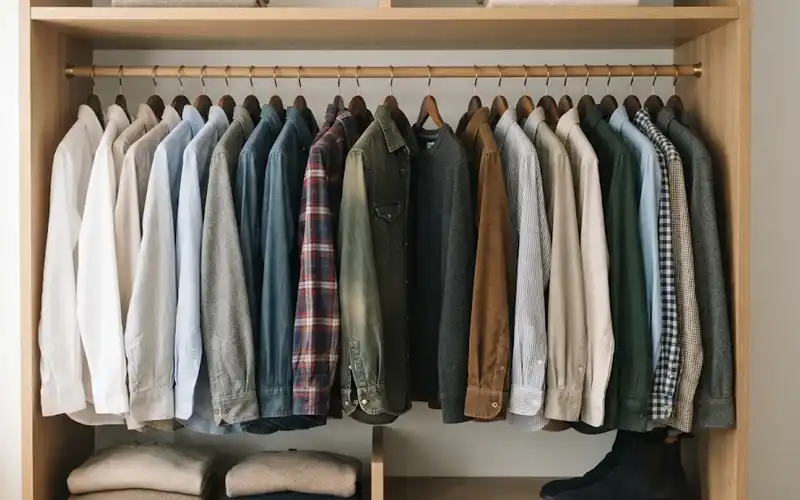
Open your closet and count the long sleeve shirts. You will probably find a mix of plaid, plain, linen, and soft knit pieces, plus a few you forgot you owned. Without a system, getting dressed turns into guesswork, and you end up wearing the same three shirts on repeat while the rest collect dust.
Learning how to categorize long sleeve casual shirts solves that problem. Once every shirt has a clear group, you can pick the right one for the weather, the plan for the day, and your mood in under a minute. The whole process is simpler than it sounds, and you only need to set it up once.
This guide keeps everything easy to follow. You will learn how to sort shirts by style, fabric, and sleeve shape, how women’s and men’s wardrobes need slightly different groups, how to match each shirt to the right setting, and how to organize and care for your collection at home.
Why Sorting Your Shirts Matters
A sorted shirt collection saves time, money, and mental energy. When you can see your shirts in clear groups, you stop buying another white button-up and start noticing what is truly missing, such as a warm flannel or a light linen option. Think of it as giving every shirt a job, so nothing sits at the back of the closet doing nothing.
Sorting also makes outfits easier to build. Each group has natural partners, so a shirt in the right category almost always works with the jeans, trousers, or jackets that suit it. Instead of testing five combinations in front of the mirror, you reach for the right group and get dressed with confidence.
Start With Shirt Style
There are many different types of long sleeve shirts, but most casual ones fall into seven style groups. Style here means the cut and design of the shirt, so fabric is left for the next section.
Classic Button-Downs
This is the group most people picture first. A classic button-down has a full front placket, a collar with small buttons that hold the points in place, and often a single chest pocket. The Oxford is the best known example. The look is neat but relaxed, which makes it easy to wear untucked with jeans, tucked into chinos, or open over a plain tee. Because it works in so many ways, it is usually the largest group in a wardrobe.
Henley and Polo Tops
Henleys and long sleeve polos sit between a T-shirt and a shirt. A Henley has a round neck with a short row of buttons and no collar, while a polo adds a soft, turned-down collar. Both slip on easily and look tidy with almost no effort. Put these in your “quick and comfortable” group, the one you reach for when you want to look put together without thinking about it.
Popover Shirts
A popover shirt has a short button placket that stops partway down the chest, so you pull it on over your head. It keeps a proper collar, which makes it look smarter than a Henley, yet it is far less fussy than a full button-down. It is a handy in-between piece for days when a tee feels too plain and a full shirt feels like too much. Store it beside your Henleys and polos.
Camp Collar Shirts
A camp collar shirt has a flat, open collar that lies against the chest and is made to be worn unbuttoned at the top. The hem is straight and the cut is boxy, so it is designed to be worn untucked. Long sleeve versions give you coverage without feeling heavy, which makes them perfect for sunny evenings and beach towns. Keep them in a separate “holiday and leisure” group, since their relaxed shape does not mix well with structured shirts.
Western Snap Shirts
Western shirts are easy to spot. They use snap buttons instead of regular buttons, and they have a pointed yoke across the shoulders and often two flap pockets on the chest. The snaps make them quick to open, and the yoke adds a slightly structured shape. Wear them with straight jeans for a classic look, or leave them open over a plain tee. Give them a group of their own, because no other style has this signature detailing.
Overshirts and Shackets
An overshirt is a sturdier shirt built to be worn over another layer, which is why it is also called a shacket. It usually has larger pockets, a thicker body, and a slightly roomier sleeve. When you sort your wardrobe, treat it as a light jacket rather than a shirt. It belongs with your outer layers, not with your everyday button-ups. Check whether yours is lined or unlined, because a lined one acts like a true jacket and an unlined one still fits comfortably over a tee.
Knit Long Sleeve Tees
Knit tees are soft, stretchy tops with no buttons and no collar. They work alone or as a base under open shirts and overshirts. Because they are so simple, they deserve a group of their own. Sorting them by neckline, such as crew or V, helps you pick one that sits under your other layers without bunching. Heavier knits, such as waffle or thermal weaves, can sit in a sub-group of their own, since they work as a main top rather than a base layer.
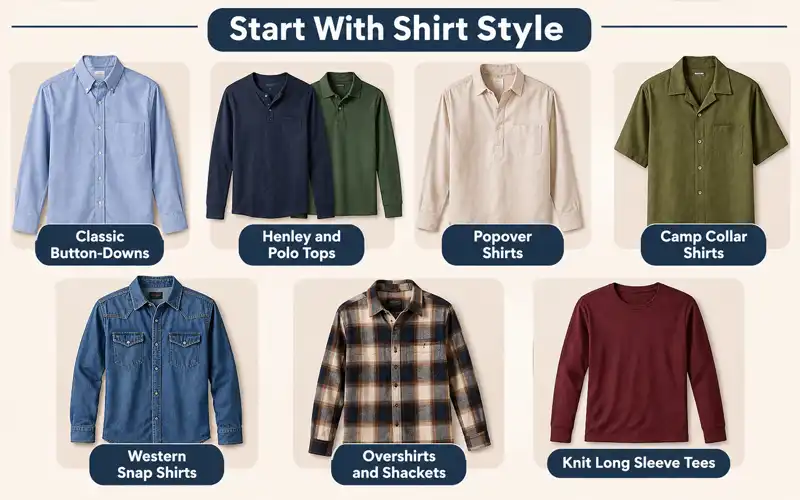
Different styles of long sleeve casual shirts, from classic button-downs to relaxed overshirts and knit tees.
Group by Fabric
Fabric tells you how a shirt feels, how warm it is, and how it will age. Sort by material and you will always know what to expect from a shirt before you put it on.
Cotton and Poplin Basics
Cotton is the everyday workhorse. Poplin is a smooth, tightly woven cotton that looks crisp and washes well, so it suits the shirts you wear most often. Group your cotton shirts together as your reliable core. They feel comfortable against the skin, take dye well, and need very little care.
Linen for Warm Days
Linen is light, airy, and naturally textured, so a few wrinkles are part of its charm. It lets heat escape, which makes it the best choice for hot, humid days. Linen also gets softer with every wash. Keep it in its own group, because its loose weave and relaxed drape do not behave like cotton.
Flannel and Brushed Weaves
Flannel is cotton or wool that has been brushed to feel soft and warm. It is the cold-weather favorite and often comes in checks and plaids. The brushed surface traps air, which is what gives flannel its cozy feel. Group these shirts together and handle them gently, since the soft surface is what makes them special.
Denim and Chambray Shirts
Denim shirts are heavy and rugged, while chambray is a lighter cousin with a soft blue look. Both are tough and look better with wear. Group them as your hard-wearing options for outdoor plans, long days, and layering over tees. Chambray works as a lighter “neutral” that goes with almost anything, while denim feels more like a jacket.
Stretch Mixes for Comfort
Some shirts blend cotton with a small amount of elastane or polyester for stretch and wrinkle resistance. They move well and keep their shape through a long day. Put them in a travel and busy-day group, since they hold up in a bag better than most other fabrics and rarely need ironing.
Spot Patterns Quickly
Pattern is a quick visual way to sort once style and fabric are done. Solid shirts are the most flexible, because they go with almost anything and make the best base for layering. Stripes, from thin pinstripes to bold Breton lines, add energy and work best when the rest of the outfit stays plain. Keep them in their own group so you never stack two busy shirts together.
Checks and plaids form the third group. Gingham and small checks feel light and tidy, while large plaids feel rugged and cozy. Prints, such as florals or subtle geometrics, round out the set and deserve a separate spot, since they act as statement pieces. A good rule is to own more solids than patterns, so your wardrobe stays easy to mix.
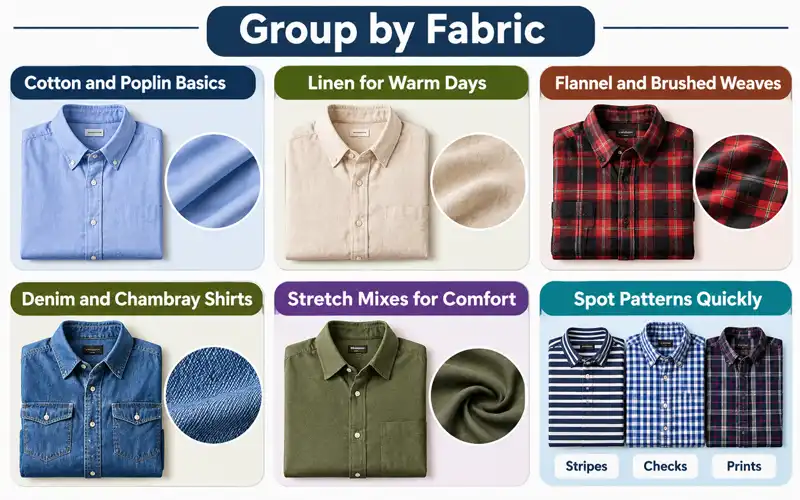
A visual guide to categorizing casual shirts by fabric, texture, and pattern.
Learn 10 Sleeve Types by Name
Sleeves are another easy way to sort. If you want types of sleeves with names and pictures, look for a clear photo or sketch next to each name below. Here are 10 types of sleeves, split into everyday shapes and statement shapes.
Everyday Sleeves for Shirts
The set-in sleeve is the standard shape, sewn into the armhole at the shoulder point for a neat, classic line. The raglan sleeve runs in one diagonal line from the collar to the underarm with no shoulder seam, so it feels sporty and relaxed. The drop shoulder sleeve has a seam that falls below the shoulder, which gives a loose and easy look. The dolman sleeve is cut wide at the body and narrow at the wrist for a smooth, draped feel.
Statement Sleeves for Fashion Looks
The bishop sleeve is fitted on the upper arm, then full and gathered at the cuff. The bell sleeve is narrow at the top and flares toward the wrist. The lantern sleeve is full through the middle and narrow at both ends. The puff sleeve is gathered at the shoulder for extra volume. The poet sleeve is soft and loose through the arm and finishes with a gathered cuff or small ruffle. The batwing sleeve is extra wide under the arm and tapers toward the wrist.
These shapes appear mostly on women’s casual shirts and blouses. Give them a separate “feature sleeve” group, because they need simpler layers on top and bottom to let the sleeve stand out.

A visual guide to 10 popular sleeve styles, divided into everyday sleeves and statement sleeves.
Women’s Long Sleeve Shirt Categories
When thinking about how to categorize long sleeve casual shirts women’s wardrobes include, silhouette and length become the most useful sorting tools. Start with three groups. Fitted shirts follow the body and look best tucked in. Relaxed shirts have softer shoulders and a looser body, and they suit a half tuck or a loose, untucked finish. Longline or tunic shirts reach the hips or beyond and are best worn over leggings or slim trousers. Cropped shirts, which stop at the waist, make a fourth group, and they pair well with high-waisted jeans and skirts.
Add a layering group for lightweight shirts that slide neatly under vests, cardigans, and blazers. Sleeve length is a quick extra check. A fitted shirt should end at the wrist bone, while a relaxed shirt can fall a little lower or be pushed up to the elbow. This small step makes outfit planning much faster.
Pair Each Shirt With a Setting
Once your shirts are grouped, matching them to a setting takes seconds. This chart shows which fabric and occasion suit each style best, and when each one shines.
| Shirt style | Best fabric | Best setting | Best time of year |
| Classic button-down | Cotton poplin | Office casual, dinners | All year |
| Henley or polo | Stretch cotton | Errands, travel | Spring, autumn |
| Popover | Cotton poplin | Relaxed work days | Spring, summer |
| Camp collar | Linen | Holidays, evenings out | Summer |
| Western snap | Chambray or denim | Casual outings | Spring, autumn |
| Overshirt | Flannel or denim | Outdoor plans | Autumn, winter |
| Knit tee | Cotton jersey | Layering, lounging | All year |
Seasons work like a simple rotation. In warm months, keep light fabrics at the front of your closet and let heavier shirts rest at the back. When the weather cools, swap them around. This keeps your closet fresh and means the right shirt is always within reach.
Choose Colors That Work Together
Color is the last sorting layer, and it works best inside your style groups rather than across them. Start with a base of neutrals, such as white, navy, grey, and beige, because these shirts match nearly everything and rarely go out of fashion. Then add earthy shades like olive, rust, and sand, which pair well with neutrals and bring warmth to a plain outfit.
Finish with one or two bold colors for variety. Within each group, line shirts up from light to dark so you can scan the row and see your options at a glance. This habit also shows you when you own too many shirts in the same shade, which helps you shop with more purpose.
Build a Closet Sorting System
Turning these groups into a real system takes about an hour, and you only do it once. Follow these steps:
- Pull every long sleeve shirt out and set aside any that no longer fit or are worn out.
- Sort the rest into style groups.
- Split each style group into light and heavy fabrics.
- Hang button-ups and overshirts, and fold knit tees and Henleys.
- Keep your most-worn group at eye level and the rest above or below.
- Add a small label or divider to each shelf so the system survives busy mornings.
Once the groups exist, keeping them tidy is easy. Put each shirt back in its own group after washing, and you will never need to sort from scratch again.
Shop Smart for Missing Pieces
Once your groups are clear, gaps show up fast. Count the shirts in each group and look for thin spots. If you own five button-downs and no overshirt, you know what to buy next. This simple count stops impulse purchases and helps you build a balanced wardrobe over time.
When you do shop, check the label for fabric content before anything else. A shirt that blends natural fibers with a little stretch often lasts longer and feels better than one made only from thin synthetic material. Look at the stitching along the collar, cuffs, and placket as well, because neat, even stitches are a good sign of a shirt that will survive many washes.
Wash and Care Basics
Care needs vary by fabric, so group your laundry the same way you group your closet. Cotton and poplin handle regular washing and look sharp with a quick iron. Linen prefers a gentle cycle and is best air dried while slightly damp. Flannel should be washed cold and dried on low heat to protect its soft brushed surface.
Denim and chambray shirts do not need frequent washing, and turning them inside out helps protect the color. Wash similar colors together and close the buttons first, which protects the placket and keeps the shape neat. Knit tees last longer when turned inside out before washing, which reduces pilling. Hanging shirts to dry whenever possible keeps them in shape for longer, and checking the care label before the first wash saves many a favorite shirt.
Frequently asked questions
What is the simplest way to sort casual shirts?
Start with style, then split each group by fabric weight. Those two steps cover most of what you need, and sleeve shape only matters for the few shirts with feature sleeves.
Can one shirt belong to more than one category?
Yes. A linen camp collar shirt fits both the camp group and the linen group. Pick the group you would think of first when dressing and store the shirt there.
Which shirt style gives the most outfit options?
The classic button-down. It works alone, open over a tee, or under a sweater, so it pairs with more of your wardrobe than any other style.
Should shirts be sorted by color or style?
Style comes first and color second. Sorting by color alone mixes shirts that need different layers and different care.
Is a Henley a casual shirt?
Yes. It is a relaxed top with a short button front, ideal for weekends and easy days. It can also pass for smart casual when paired with chinos.
Are five to eight shirts enough?
For most people, yes. A button-down, a Henley, a flannel or overshirt, and a linen or camp collar shirt make a solid base, and you can add from there.
Where should unmatched shirts go?
A shirt that fits no group usually does not match the way you dress. Donate it, or keep it only if you truly love wearing it.
Final Thoughts
Knowing how to categorize long sleeve casual shirts turns a messy closet into a simple toolkit. Sort by style first, then fabric, then sleeve shape, and adjust the groups for your own wardrobe and the settings you dress for. A few small habits, like returning shirts to their group after washing, keep the system working. Remember that no system has to be perfect. If a shirt does not fit neatly into one group, go with the group you would reach for first and move on. The goal is a closet that saves you time every morning, so start with one shelf this weekend, and the rest will follow easily.