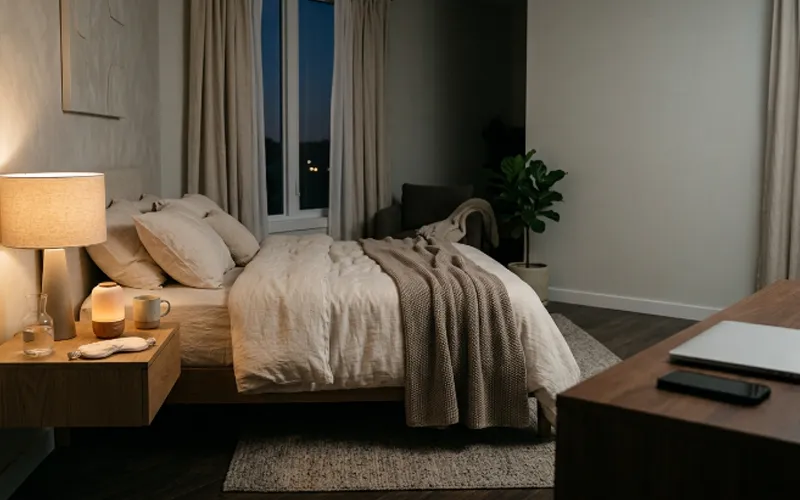
Why the Last Twenty Minutes of Your Day Belong to You
Most people cannot answer this question. Ask and you will get a schedule rather than an endpoint. “I stop working around seven” is when the work stops. It is not when the day ends.
The space between these two moments is where the real issue begins. Between the last task and the last thought there is usually a stretch of an hour or more that belongs to no one. It is spent on a sofa, on a phone, or on nothing that anyone would describe as rest.
Table of Contents
ToggleTry a smaller, answerable version of the question:
| Question | What it usually reveals |
| When do you stop working? | A credible time, often accurate |
| When do you stop being available? | A time that is later than you thought |
| When do you last do something for yourself? | Frequently yesterday, or not this week |
| What are the last twenty minutes spent on? | Usually a screen |
The last twenty minutes are the only part of the day nobody else has a claim on. They are also the part most likely to be handed over by default.
Why Hardware and Not Another App
The reflex answer is an app. The problem is that the app lives on the same object that produced the day.
An app has to be opened. It sits behind notifications. It asks you to log something, and it is on the device you have already used for eleven hours. You are attempting to end your day using the tool that made it long.
This is the case for a dedicated AI-powered wellness device rather than a tab in the browser, an object that does one thing, is not connected to your inbox, and has no feed to fall into.
Why physical objects work better at this hour:
- No feed. There is nothing to scroll, so there is no decision about stopping.
- One function. No feature list to consider when you are already tired.
- No social surface. Nothing needs your attention, and no one is waiting for a response.
- Presence. An object on the nightstand reminds you that twenty minutes exist. A notification does not.
The rule of thumb is simple. Any help you need in the last hour of the day should arrive as a thing, not as an account.
Three Things That Slow the Evening Down
Not routines, subtractions. Each of these removes a decision rather than adding a step.
- A fixed endpoint, not a fixed bedtime. Decide that the day ends at a time, not that you will sleep at one. Sleep follows the endpoint. It rarely follows an intention.
- One closed door. Put the day’s work behind a physical action, a closed laptop, a closed drawer. The gesture does the arguing for you.
- Something that runs without your input. Ambient light, a warm shower, a device already configured. The fewer things you have to start, the fewer chances the evening has to go sideways.
Three is the right number. Lists longer than three become projects, and projects get postponed.
What the Twenty Minutes Are Not For
The most common mistake is turning the last twenty minutes into a performance metric.
| Not this | Because |
| A journalling streak | A missed night becomes a failure |
| A sleep score | Optimising sleep interferes with it |
| A new skill | Learning is not rest |
| A catch-up window | It reopens the day you just closed |
Anything with a score attached will eventually be gamed, including by the person setting the score. The value of this hour comes from it being unmeasured.
How the Last Hour Looks on a Bad Day
Any routine that only survives a good day is not a routine. It is a mood. The useful test is what happens in the evening when nothing went right, work ran late, someone needed something, and you are already past the point where you wanted to be asleep.
On those nights, the version that works is smaller than the one you planned.
| Planned version | Bad-day version | Still works? |
| Twenty minutes of quiet reading | Five minutes, lights down | Yes |
| A full wind-down sequence | One repeated action | Yes |
| No screens after nine | Phone face down, not in the room | Partly |
| Bed at a fixed time | Bed within the same hour | Yes |
The row that matters is the last one. Consistency of hour survives bad days better than consistency of minute, and a routine that bends without breaking is worth more than one that is abandoned twice a month.
Personalization You Never Have to Set Up
Most personalization is homework. You answer questions, pick a goal, adjust a slider, and then you are told to keep it up.
There is a better model, and it is the one this category is quietly built on: AI-powered sensual wellness that calibrates from use rather than from a setup screen. Nothing to configure, nothing to remember, nothing to explain to anyone.
| Traditional setup | Set-up-free approach |
| Onboarding questionnaire | Nothing to complete |
| Manual intensity settings | Adjusts from how it is used |
| Daily check-in prompts | No prompts at all |
| Progress dashboard | No dashboard to disappoint you |
That last row matters more than it looks. Dashboards create obligations, and obligations at eleven at night are just one more item on the list you were trying to close.
The Gift for the Friend Who Never Slows Down
There is a specific kind of person this fits: competent, booked, and quietly running on empty. She does not need another candle, and she will not use a meditation subscription.
What she will use is something that requires no explanation, sits where she already is, and does not ask her to change her personality in order to benefit from it.
If you are buying it for someone, the useful framing is not “treat yourself.” It is:
- It is not a project. Nothing to set up, no streak to maintain.
- It is not visible. Nothing for a guest to ask about.
- It is not time-consuming. Twenty minutes, at the end, when nothing else is scheduled.
The twenty minutes at the end of the day are the cheapest improvement available to most people, and the hardest to protect. Protecting them is easier with a thing on the nightstand than with a resolution in your head.
Frequently Asked Questions
1. What are the last twenty minutes of your day for?
The last twenty minutes of your day can be used for relaxation and personal time. It is a chance to step away from work, screens, and other responsibilities before going to bed.
2. Why are the last twenty minutes of your day important?
They give you a clear endpoint to your day. Using this time for yourself can help you slow down and create a calmer transition from work to rest.
3. How can I relax in the last twenty minutes of my day?
You can dim the lights, take a warm shower, read quietly, or simply sit without using your phone. The goal is to keep the routine simple and relaxing.
4. What should I avoid during the last twenty minutes of my day?
Try to avoid work, social media, emails, and activities that require a lot of attention. These activities can make it harder to mentally end the day.
5. How can I create a simple evening routine?
Choose a fixed time when your day ends and repeat one or two simple actions each evening. For example, close your laptop, put your phone away, and spend a few quiet minutes relaxing.
6. Can the last twenty minutes of the day reduce stress?
A quiet end to the day may help you feel less mentally busy. Taking time away from work and screens can create a more peaceful transition into the night.
7. Why is screen-free time helpful before bed?
Screens can keep you engaged with messages, social media, and other content. Putting your phone away gives your mind a chance to move away from the activities of the day.
8. What is an AI-powered wellness device?
An AI-powered wellness device is a physical product designed to support personal relaxation or wellness. Unlike an app, it can be a dedicated object that does not require you to open a phone or browse through other content.
Tags