Getting Engaged? Here’s Why Moissanite Is Having a Style Moment
Engagement ring shopping used to mean one conversation: diamond or nothing. That’s changed. More couples are walking into jewellers asking specifically about moissanite, and it’s not just a budget workaround anymore. It’s become a genuine style choice.
Table of Contents
ToggleWhat Moissanite Actually Is
Moissanite started life as a natural mineral, discovered in a meteorite crater back in the 1890s by a French chemist named Henri Moissan. Naturally occurring moissanite is so rare it’s basically never used in jewellery; what you’ll find in rings today is lab-created, grown under controlled conditions that replicate its crystal structure. It’s not “fake diamond.” It’s its own gemstone, with its own optical properties, and some of those properties actually outshine diamond in specific ways.
The refractive index is the big one. Moissanite bends light more aggressively than diamond does, which is why it throws off those flashes of rainbow colour (called fire) more noticeably. Some people love that extra sparkle. Others find it a bit much under certain lighting, and getting a proper read on it usually means seeing the stone in person rather than going off photos alone. This is where talking to specialists helps: the team behind Moissanite Rings by Cullen Jewellery fields these questions daily and can walk you through which cuts suit which lighting conditions, something worth leaning on before you commit to a stone you’ve only seen on a screen.
Why It’s Suddenly Everywhere
A few things have converged at once. Lab-grown gemstones lost their stigma years ago, and younger buyers in particular don’t carry the same “natural or bust” mentality their parents might have. There’s also a cost factor that’s hard to ignore: moissanite typically runs a fraction of the price of a diamond of comparable size, which means couples can go bigger on the centre stone or put the savings toward the wedding, a house deposit, whatever matters more to them.
A few things have converged at once. Lab-grown gemstones lost their stigma years ago, and younger buyers in particular don’t carry the same “natural or bust” mentality their parents might have. There’s also a cost factor that’s hard to ignore: moissanite typically runs a fraction of the price of a diamond of comparable size, which means couples can go bigger on the centre stone or put the savings toward the wedding, a house deposit, whatever matters more to them.
Instagram and TikTok haven’t hurt either. Ring reveal videos favour stones with maximum sparkle on camera, and moissanite photographs brilliantly. Whether that’s a good enough reason to choose a stone is debatable, but it’s undeniably part of why searches for it have climbed the way they have.
The Trade-Offs Nobody Skips Over
It’s not a perfect substitute and shouldn’t be sold as one. Moissanite has a slightly lower refractive quality in terms of how “white” it reads compared to a top-grade diamond; some stones can show a faint grey or greenish tint in certain light, though the better-cut ones minimise this considerably. Resale value is also weaker. Diamonds hold a market, however imperfect; moissanite doesn’t have the same secondary market, so if resale matters to you, factor that in before you commit.
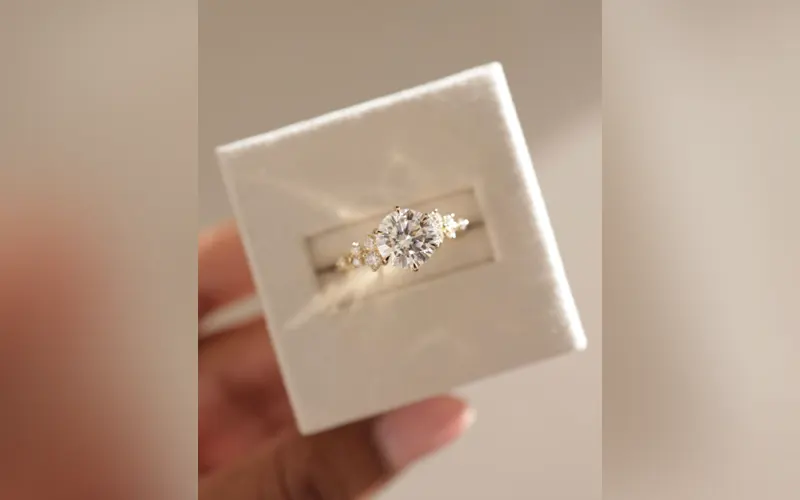
Cut quality matters enormously with this stone, arguably more than with diamond. A poorly cut moissanite looks glassy and obviously synthetic. A well-cut one is genuinely difficult for most people to tell apart from a diamond without a jeweller’s loupe, which is exactly why sourcing from a jeweller who specialises in the stone makes such a difference to the end result.
Making the Decision
There’s no universal right answer here. If sparkle and value for size are the priority, moissanite delivers on both fronts convincingly. If long-term resale or the emotional weight of “natural” matters to you as a couple, that’s a legitimate pull toward diamond, and neither choice reflects poorly on the relationship or the commitment behind it.
The ring is meant to represent something specific to the two people wearing and giving it. Getting hung up on what everyone else considers “correct” misses the point of the exercise entirely.
Frequently Asked Questions
- What are moissanite engagement rings?
Moissanite engagement rings feature a lab-created gemstone known for its brilliant sparkle, durability, and affordability. They are a popular alternative to traditional diamond rings.
- Are moissanite engagement rings worth buying?
Yes, moissanite engagement rings can be an excellent choice for couples who want a beautiful, durable gemstone without spending as much as they would on a diamond.
- Does moissanite look like a real diamond?
Moissanite can look similar to a diamond, but it produces more noticeable rainbow-coloured flashes because of its different optical properties.
- How long do moissanite engagement rings last?
Moissanite is highly durable, with a hardness rating of 9.25 on the Mohs scale. With proper care, a moissanite engagement ring can maintain its beauty for many years.
- Do moissanite engagement rings lose their sparkle over time?
Moissanite does not typically lose its natural brilliance over time. However, dirt, oil, and everyday residue can make it appear dull. Regular cleaning helps restore its sparkle.
- Can people tell the difference between moissanite and diamond?
Some people can distinguish them by observing their sparkle and optical characteristics. However, telling them apart can be difficult without specialised jewellery tools.
- Do moissanite engagement rings have good resale value?
Moissanite generally has a weaker resale market than diamonds. Buyers who prioritise long-term resale value should consider this factor before purchasing a ring.
- Is moissanite suitable for everyday engagement ring wear?
Yes, moissanite is suitable for everyday wear because of its excellent hardness and resistance to scratching. Choosing a secure setting and cleaning the ring regularly can help maintain its appearance.
Tags