

You swatch a shade in the shop, it looks flawless, and then daylight reveals an orange mask floating above a paler neck. Wrong matches are common because shade names are inconsistent, lighting is unforgiving, and most advice stops at “check your veins.”
Quick answer: to find your foundation shade, identify your depth (fair to deep) and your undertone (cool, warm, neutral, or olive), then swatch three neighboring shades along your jawline, wait ten minutes, and check them in daylight. The shade that disappears into your skin is your match.
This guide shows you how to find your foundation shade step by step: your depth, your undertone, a testing method that works, and what to do when you cannot test at all. You will also learn how online tools, photo-based finders, and cross-brand conversions really work, so you can shortlist with confidence and buy once.
Why Your Foundation Never Seems to Match
Most mismatches trace back to four causes: ignoring undertone, trusting shade names, judging a swatch in poor light, and skipping the settling time every formula needs. None of them is about your skin being “difficult.” They are process problems, and process problems have clear fixes.
The sections below follow the order you will meet these problems in real life. Start with understanding your own coloring, then move to testing, and only then think about buying online or without a swatch.
Skin Depth Explained: Fair to Deep
Depth is simply how light or dark your skin is, and it is the first filter that narrows hundreds of shades to a handful. Judge it on a cleansed, bare face rather than on an arm or hand that has seen more sun.
Fair and Light Complexions
Fair and light skin tends to show redness easily, so a base with too much pink can make cheeks look flushed. A neutral or faintly yellow lean usually reads more natural here.
Medium and Tan Complexions
This range is the widest, so most lines offer many close steps. Small gaps matter: a base half a step too light turns chalky, while half a step too deep looks muddy.
Deep and Rich Complexions
Deep complexions are often poorly served by narrow ranges, which is why shades can drift gray or ashy. Look for lines with several deep steps and distinct warm, neutral, and cool options.
Undertones Decoded: Cool, Warm, Neutral, Olive
Undertone is the subtle color beneath the surface of your skin. It stays constant when you tan, flush, or fade, which is why two people with the same depth can need completely different bases.
Surface tone, sometimes called overtone, is a different thing. Redness, sun damage, and breakouts sit on top of your undertone and can change from week to week. A slightly warmer or neutral base can soften redness, but only within the range that still disappears at the jaw, so match the undertone first and treat surface concerns second.
Use this quick reference when you read shade labels.
| Undertone | Label words to look for | Bases to avoid |
| Cool | Cool, rose, pink | Heavily yellow or orange bases |
| Warm | Warm, golden, yellow, peach | Heavily pink bases |
| Neutral | Neutral, beige | Strongly pink or strongly yellow bases |
| Olive | Olive, golden olive, neutral olive | Pink or orange bases |
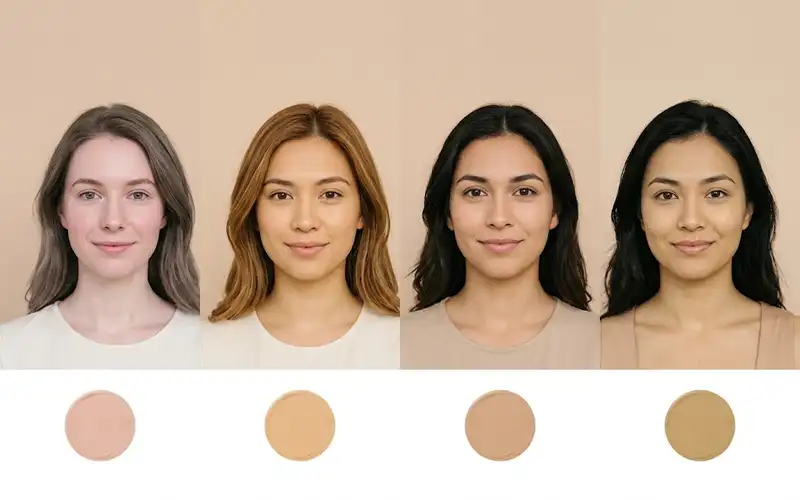
Cool, warm, neutral, and olive: find your undertone before you pick a shade.
Pink, Blue, and Rosy Signals
Cool undertones lean pink, rosy, or slightly blue. Bases for this group usually carry a hint of pink or red so the skin does not look sallow.
Golden, Peachy, and Yellow Signals
Warm undertones lean yellow, peach, or golden, and the skin often looks sunlit. Pink-heavy bases tend to look cold or mask-like on this group.
Balanced Signals
Neutral undertones sit between warm and cool, so no single tint dominates. Many people with a neutral undertone can wear shades from either side, which also makes them easy to mislabel.
Greenish and Muted Signals
Olive undertones carry a soft green or gray-green cast beneath a yellow base. They are often mistaken for warm or neutral, and a base that is too pink or too orange turns olive skin sallow. Look for shades described as olive or golden with a subtle green lean.
At-Home Tests That Actually Reveal Your Undertone
Treat each test below as a clue, not a verdict. Two or three results that agree are far more useful than one result you trust blindly.

Wrist veins, a white cloth, and jewelry: three easy clues to your undertone.
Wrist Veins Check
Look at the inside of your bare wrist. Blue or purple veins suggest a cool undertone, green suggests warm, and a mix suggests neutral. On deeper complexions veins can be hard to see, so lean on the other checks.
White Fabric Comparison
Hold a plain white cloth beside your bare face. Skin that looks pinker against it leans cool, skin that looks yellower leans warm, and a gray-green cast hints at olive.
Metal Jewelry Check
If gold flatters you more, your undertone is likely warm. If silver does, it is likely cool, and if both work equally well, it is probably neutral.
Sun Reaction Clue
Skin that burns quickly and turns pink often leans cool, while skin that tans easily often leans warm. This reflects melanin more than undertone, so use it only as a supporting clue.
A Foolproof Way to Find Your Foundation Shade
The most dependable method to find your foundation shade is a three-shade swatch test done on prepared skin. It takes about fifteen minutes and removes most of the guesswork.
Prep the Skin First
Cleanse and moisturize, then let the moisturizer absorb for a few minutes. Dry patches and oily spots both change how a base sits and can fake a mismatch.
Pick Three Neighbouring Shades
Choose the shade you think is right, plus one step lighter and one step deeper, all within your undertone family. Testing neighbors shows you the exact direction of any error.
Swipe Along the Jawline
Apply three short stripes along your jawline and blend each lightly. The jaw sits between face and neck, so the winning stripe will bridge both. The hand or wrist is a poor test area because it usually has a different depth from your face.
Wait Ten Minutes
Many formulas darken or shift slightly as they react with skin oils and air. Give each stripe about ten minutes, then choose the one that has faded into your skin, not the one that looked best in the first second.
Check in Daylight
Step to a window or outside and look at the stripes. Shop and bathroom lighting can make a shade look right when it is not. The winner is the stripe you can no longer see on your jaw or neck.
Online Shade Matching Without Guesswork
Learning how to find your foundation shade online starts with accepting that screens distort color. Online tools are best at shortlisting two or three candidates, and the final decision should always be backed by a sample, a return option, or both.
Foundation Shade Finder Tools Explained
A foundation shade finder usually works in one of two ways. Quiz-based tools ask about your depth, undertone, and finish preferences, then filter a catalog. Camera-based tools analyze skin pixels and compare them with a shade database. Quizzes are only as accurate as your answers, so complete the undertone checks above before you start. Results often arrive as a ranked list, so read the second and third options too, because they can reveal the undertone the tool was hesitating between.
Using a Foundation Shade Finder With Photo
A foundation shade finder with photo needs a clean input. Take the selfie with a bare face, no filters or beauty mode, hair pulled back, and the camera at arm’s length facing the same light you used for the daylight check. If the tool asks for a reference card or a neutral gray background, follow it exactly, because the software uses it to correct color casts.
Phone Apps for Quick Shade Matching
Type how to find your foundation shade app into any store and you will get dozens of results, so apply a few filters. Prefer apps that show several shades side by side, explain how they detected your undertone, and let you compare results across different formulas. Avoid any app that shows a single match with no reasoning, since you cannot judge how reliable it is. Check what the app does with your photos, including whether it stores them, before you upload a clear picture of your face.
Free Options to Find Your Shade Online
If you want to know how to find your foundation shade online free, there are several no-cost routes: browser-based quizzes, camera try-on tools, free sample requests, and live chat with a beauty advisor. Sample requests are the strongest of these because they let you test a real formula on your own jawline before you spend anything. That also answers how to find your foundation shade free of cost: samples and quizzes cost nothing, while a wrong bottle always does.
Cross-Brand Matching From a Shade You Own
A foundation shade finder based on other brands uses a shade you already know works as its starting point. Note the depth word, the undertone letter or word, and any number printed on the bottle you own. Then enter those details into a conversion tool, or search a shade-matching database that lists equivalents across ranges.
Treat the result as a shortlist of two or three candidates, not a guarantee. Shade names are not standardized, so one range’s “medium” can sit closer to another range’s “light,” and different finishes can read as different colors on the same skin. Always base the search on a shade that was a true match, not one you settled for, and confirm the shortlist with a swatch or sample before committing.
Keep a short record of every conversion you test, noting which shortlisted shade finally worked. Over time this becomes a personal reference that is more reliable than any database, and it makes the next switch much faster.
Without Testing: Buying With Confidence
How to find your foundation shade without testing comes down to collecting evidence before you pay. A few habits do most of the work.
Plan for two attempts rather than one. Treating the first purchase as data instead of a failure makes it easier to stay calm, and the shade you return or sample tells you which direction to adjust next.
Read Reviews With Shade Details
Search for reviews that state the reviewer’s own shade and undertone, then follow people whose coloring matches yours. Ignore comments that say “perfect match” without any detail.
Study Swatch Photos on Real Skin
Look at customer photos and swatch images on skin similar to yours, not just the circular color chips. Chips ignore how a formula blends and settles on real skin.
Order Small Sizes or Samples
Mini sizes, sachets, and sample cards cost far less than a wrong full bottle. They also let you wear the formula for several days instead of a few minutes.
Lean on Return Policies
Choose sellers that accept returns or exchanges on opened beauty products, and keep the packaging until you are certain of the match.
Formula and Finish Change the Way Shades Look
Finish changes how a shade reads. Matte formulas can look slightly flatter and deeper, while dewy formulas and skin tints look brighter and lighter because they reflect more light. A shade that works in one finish may need a half-step change in another.
Skin type should guide the finish. Oily skin usually wears matte or soft-focus textures better, dry skin favors hydrating liquids and tints, and combination skin often suits lightweight satin finishes. Decide the finish before you swatch so you are testing the right formula.
Coverage matters too. Sheer tints forgive small mismatches because your own skin shows through, while full-coverage formulas hide your natural color and make any error obvious, so be stricter with the swatch test as coverage increases.
Seasonal Skin Shifts and Your Shade
Skin changes with the seasons, so a shade that matched in winter can feel off by midsummer. Re-swatch at the start of each season rather than guessing, since a shift of about one step is typical. Buy a second shade only if the new swatch no longer disappears.
Going Lighter or Deeper: Which Is Safer?
Aim for an exact match, but if you must err, a slightly lighter shade is usually more forgiving at the jawline than a slightly deeper one, which tends to leave a visible edge.
If your neck is noticeably lighter or deeper than your face, match the face and blend lightly downward so the change in color looks gradual.
Mistakes That Lead to the Wrong Match
Some errors survive even a careful swatch session. Matching on irritated, sunburned, or freshly treated skin gives a result that will not hold once the skin recovers, so wait until it settles. Trust a screen only after checking its settings, because night mode, battery saver, and brightness changes all shift the colors in online swatch charts.
The quietest mistake is buying the shade you wish you had. A lighter or tanner color may look great on a mood board but detached from your neck. Choose what disappears, not what impresses.
Watch out for judging by the bottle as well. The liquid inside a bottle or on a testing card looks deeper than it will once it is spread thinly on skin, so base your decision on the blended stripe, never on the color of the packaging or the pump.
Quick Fixes When a Shade Is Slightly Off
A shade that is nearly right is still usable. Mix two shades in your palm to land between steps, or add a drop of a lighter shade if the base is a touch too deep.
If the base looks slightly pale, a little bronzer blended around the edges of the face brings back warmth. These are patches, not substitutes for a proper match.
Technique can fix a lot as well. Apply a thin layer with a damp sponge, concentrate it on the center of the face, and blend outward so the edges stay close to your natural skin. Build coverage only where you need it instead of starting with a heavy layer.
Your Pre-Purchase Checklist
- Two undertone checks point to the same result.
- You have tested three neighboring shades, not one.
- You hold a sample or a return option before paying in full.
- You have written down the exact shade name and code for future reorders.
Questions People Ask Most
Can I match a shade from a photo alone?
A photo can reveal your depth and undertone family, but it cannot show finish, texture, or how a formula settles on your skin. Use it to narrow the field, then confirm with a sample.
Is a free shade finder accurate?
Accuracy depends mostly on your input. A clean, filter-free photo and honest quiz answers produce usable results, while rushed answers do not. Most free tools are accurate to the right family of shades rather than the exact one.
What if I fall between two shades?
Decide by undertone first, because a slightly lighter or deeper base is easier to adjust than the wrong tint. Pick the shade with the right undertone and fine-tune depth afterwards.
Does shade change after application?
Yes, it can. Beyond the early settling period, oil and sweat can deepen or dull a base through the day, which is why a ten-minute test is more reliable than a first impression.
Are app results reliable for deep tones?
They can be, but quality varies. Check whether the tool shows results on a range of deep complexions and offers distinct undertones rather than only lighter examples. If it does not, confirm any match with a sample.
Will I need more than one shade a year?
Only if your skin shifts visibly. A quick check is to photograph a swatch on your jawline now and compare it at the next season change. If it no longer disappears, it is time to re-test.
Should concealer match my foundation shade?
For covering blemishes or redness, match concealer to your foundation or go one step deeper. For brightening the under-eye area, choose one step lighter and keep the same undertone so it does not look gray or orange.
Flash photos make my base look gray. Why?
This is flashback. Some sun-protection and powder ingredients reflect camera flash and make a base look lighter or ashy. Take a flash photo of your swatch stripes before you decide, especially if you are shopping for events.
Final Thoughts
Finding the right match is less about luck and more about method: identify your depth and undertone, test properly, and use online tools to shortlist rather than decide. Once you know how to find your foundation shade, every future purchase becomes a quick check instead of a gamble. Start with one clean jawline swatch this week and let the result guide your next purchase.