
Foundation that turns rosy by lunchtime, a golden shade that looks muddy, and a nagging feeling that your skin fits no label: if that sounds familiar, you are probably wondering how to know if you have olive skin. The short answer is that olive skin carries a subtle green, grey, or muted yellow cast, and it usually tans easily instead of burning.
Below you will find seven signs you can check with just a mirror and daylight, a chart covering every olive skin tone from pale to deep, undertone guidance, and makeup advice that actually works. Read on, and you may finally understand why shade matching has always felt so hard.
Seven Signs You Can Spot at Home
No single sign proves anything. Treat each one as a clue, and look for a pattern across several. Use natural daylight near a window, with no makeup and no tanning products on your skin.
Tanning Instead of Burning
Think back to how your skin handles a day outdoors. Olive skin tends to darken gradually with sun exposure instead of turning red first. Keep in mind that tanning is only a hint, since many skin tones tan, and olive skin can still burn without sunscreen.
Wrist Veins That Look Green
Turn your wrist toward the window and look at the veins under the skin. Veins that read more green than blue or purple point toward an olive cast. This works best on fair to medium skin and becomes unreliable on deeper complexions, where veins are harder to see, so lean on other signs if that is you.
Silver or Gold Jewelry Test
Hold a silver piece and a gold piece against your bare skin, one after the other. If gold makes you look slightly grey or tired while silver looks crisp, you may lean cool olive. If gold glows and silver flattens you, a warmer olive is possible. Olive skin often sits in between, so both metals can look decent.
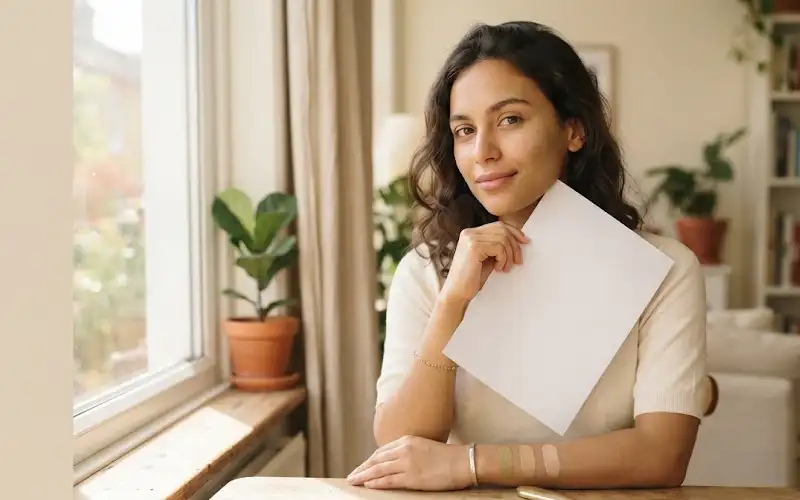
White Paper Skin Check
Hold a plain white sheet of paper beside your jaw and compare. Against the bright white, olive skin often re
veals a dusty green, grey, or yellow-brown cast instead of pink or peach. Pink-toned skin looks flushed beside the paper, which makes the difference easy to see.
Foundation That Turns Pink or Yellow
Think about your past makeup purchases. A pink-based shade that turns rosy or lilac on you, plus a golden shade that looks muddy or orange, is a classic pattern for olive skin. Neutral shades come closer but still seem slightly off. This is a sign of a mismatch in the base, not a sign that you are hard to match.
Warm Colors Making You Look Tired
Hold a mustard, orange, or bright coral top up to your face. If those colors drain you and make your skin look sallow, your complexion may have an olive overtone. Jewel colors such as emerald, teal, and deep plum usually do the opposite and make your skin look clearer.
Natural Hair and Eye Clues
Many people with olive skin have dark brown or black hair and brown or hazel eyes. That pairing supports the other signs, but it proves nothing alone. Pale olive people can have light brown or even blonde hair, so use this clue only to back up what the rest of your tests show.

Seven easy daylight checks to help you spot olive skin at home. No single sign proves it, so look for a pattern.
Scoring Your Results Across All Seven Signs
Treat the seven signs as a quick olive skin quiz you can run at home: no single one settles the question, so count how many point the same way. Give yourself one point each time your result matches the olive description above: a tan instead of a burn, greenish veins, a muted cast beside plain paper, and so on. Write the score down along with the date, so you can compare it later.
Four or more points make olive skin likely. Two or three points suggest you could be olive with a soft cast, or one of the lookalike tones covered further down. One point or none usually means another skin tone. On deeper skin, count the jewelry and white paper results twice.
If your signs contradict each other, do not force a verdict. Repeat the tests on a different day, and bring the results to a professional if they still conflict.
Testing Errors That Skew Results
The most common mistake is testing while wearing a colorful top. A red shirt throws a pink glow onto your face, and a green one can make you look greyer than you are, so wear plain white or grey. Flushed skin is another trap: right after a workout, a hot shower, or a long walk in the sun, redness can hide your real cast.
The last error is wanting a particular answer. Once you suspect you are olive, it is easy to read every result that way. Ask a friend with a neutral eye to compare the tests with you, and trust the pattern across several signs more than a single ambiguous moment in the mirror.
Ancestry and Olive Skin Tone Ethnicity
Family background can add context, but it is not a diagnosis.
Regions Where It Appears Often
Olive skin tone ethnicity patterns show up across the Mediterranean, North Africa, the Middle East, South Asia, and Latin America. People with roots in these regions often have the complexion, though plenty of people from elsewhere do too.
Why Heritage Is Only a Hint
Mixed ancestry makes skin tone far harder to predict from family trees. Siblings can even look different from each other. Trust what you see on your own skin more than what your family history suggests.
Reference Chart for Every Depth
This olive skin tone chart shows how the complexion changes from light to deep. Use it to see where you might fall, not as a rigid rulebook.
| Depth | Overall Look | Most Useful Clue | Starting Shade Family |
| Pale | Muted, neutral, sometimes slightly grey | White paper test | Desaturated neutral or neutral-cool |
| Light to medium | Soft green-yellow cast, tans easily | Vein and foundation clues | Olive-labeled or neutral-yellow |
| Tan | Earthy, golden-brown with a muted base | Warm colors looking dull | Neutral-olive or deep neutral |
| Deep | Rich with a subtle grey-green sheen | Jewelry and white paper | Deep olive or deep neutral |
Pale Olive Skin Without the Green Look
Pale olive skin rarely looks green. It tends to look neutral and slightly muted, which is why many fair-skinned people never realize they are olive. The clues are subtle: you are the palest shade in most ranges yet still look a little dull, pastel colors wash you out, and soft muted colors suit you better than bright ones.
Because the cast is so faint, pale olive is the tone most easily misread as plain fair or neutral. Look at the thinnest skin, around the mouth and under the eyes, for a faint grey-beige quality, and compare yourself with a friend of similar paleness in the same light. If the two of you look clearly different, your overtone is probably doing the work.
Medium and Tan Olive Shades
This is the most common group, and it is often mistaken for plain medium or tan skin. The giveaway is a tan that looks muted and slightly green-brown instead of golden-bronze, even after weeks in the sun.
Because this group sits in the middle of most shade ranges, a close-enough match is easy to find, and that is exactly why the cast goes unnoticed for years. If you have always settled for a near match, take that as a reason to run the signs above again.
Deep Olive Complexions
On deeper skin the green cast is subtle and easy to miss, because rich color tends to hide it. Look at where the skin catches light instead: a cool, slightly ashy sheen on the cheekbones, and a brown that reads earthy instead of red or golden-bronze, both point toward a deep olive overtone.
This group is the one most often left out of shade ranges, so many deep olive shoppers go years without a proper match. Searching by undertone words such as neutral or olive, and not by depth names alone, tends to surface better options.
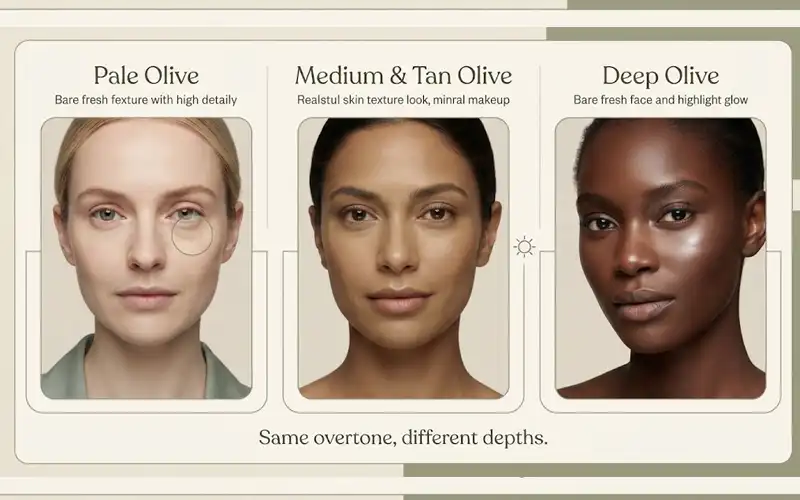
Olive skin looks different at every depth, from pale and muted to rich and earthy.
Lookalike Tones That Get Mistaken for Olive
Several complexions share traits with olive skin, which is why so many people end up with the wrong label. These three comparisons help you separate them.
Golden Warm Skin
Golden skin glows with a clear yellow or peach warmth, and it looks radiant in sunlight. Olive skin is more muted, with a grey or green softness that dims that glow. If your skin looks sunny instead of earthy, you are more likely golden than olive.
Sallow or Tired-Looking Skin
Sallow skin looks yellowish and dull because of fatigue, dehydration, or poor sleep, and it often improves with rest. Olive skin keeps its muted cast every day, in every season. A sudden, lasting yellow tint, especially in the whites of the eyes, is a reason to see a doctor and not a skin tone question.
Beige Neutral Skin
Neutral beige skin lacks a distinct cast and looks balanced in almost any color you hold near it. Olive skin always carries a faint dusty tint, so some colors flatter you while others clearly clash.
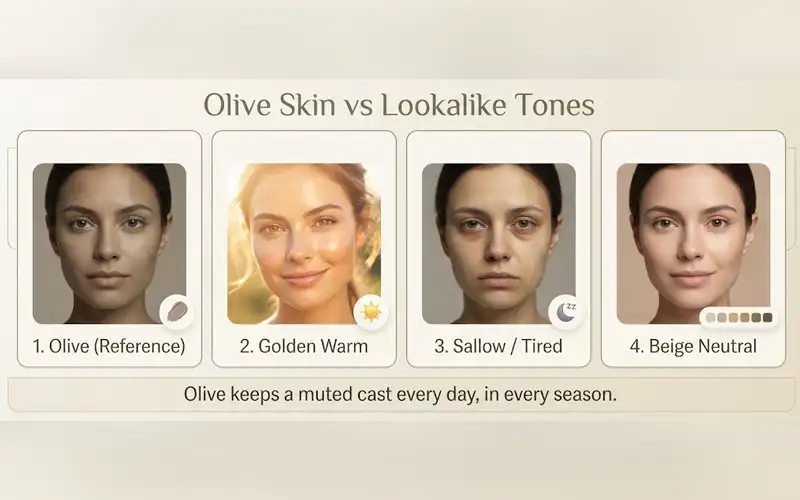
Golden, sallow, and beige skin can look similar to olive, but only olive keeps a muted, dusty cast every day, in every season.
Undertone Under the Olive Surface
Once you know you are olive, the next question is what sits beneath it. Experts describe olive in different ways: some call it an overtone that sits on the surface, others treat it as part of the undertone, and both describe the same muted green-grey cast. What matters here is the base underneath it, which can be cool, neutral, or warm.
Cool Olive Skin Tone Signs
A cool olive skin tone often shows redness that looks bluish-pink when irritated, and dark marks that look greyish-brown. Tanning tends to give a cool, ashy brown instead of a golden one.
Neutral and Warm Variations
Neutral olive sits halfway, so both cool and golden shades work to a degree without ever feeling perfect. Warm olive is less common and shows up as a golden-green glow, with copper or honey tones appearing in the sun. If you are warm olive, earthy shades such as olive green and terracotta may suit you better than they would suit a cool olive.
Lighting Tricks and Camera Traps
Light changes how olive skin reads more than it does for most tones. Cool fluorescent bulbs push it greener and flatter, while warm yellow bulbs hide the cast and make skin look golden. Mixed lighting in changing rooms and bathrooms is why a shade that looked perfect in the store can look wrong at home.
Phones add another layer. Front cameras and filters often boost warmth or smooth out color, so a selfie can make you look more orange or pink than you are. When you take photos for comparison, use open shade and switch off filters and beauty modes.
Seasonal Shifts and Skin Changes
Your overtone is fairly stable, but your depth is not. Summer sun, winter paleness, hormonal changes, and aging can all make the same skin look lighter or darker. Redness from irritation or rosacea can also mask an olive cast for a while.
Because of this, it pays to retest once a season by repeating two or three of the home checks. Expect to move one shade lighter or deeper in the same foundation family, instead of switching to a different family altogether.
Makeup Choices That Flatter
This section is about shopping and application, so you can put your skin tone to work.
Picking Olive Skin Foundation
Choosing an olive skin foundation starts with undertone-friendly shade families. Look for shades labeled olive, or for neutral shades with a muted yellow base. Swipe three shades along your jawline, check them in daylight, and wear the best one for a few hours before committing. Many brands now offer dedicated olive ranges, so check the shade finder before settling for a near match.
Blush, Lipstick and Eyeshadow
Berry, plum, and rosewood blushes add life without looking harsh. For lips, try deep rose, wine, and brick-red with a hint of brown. For eyes, bronze, taupe, and slate bring out natural depth.
Mistakes That Make Skin Look Dull
Avoid heavy orange blush and very peachy concealer. These tricks add more color than your skin needs. A well-matched base solves the problem at its source.
Smart Shopping When Shades Run Short
Many ranges still skip olive shades, so you may need a workaround. Start with a sister shade: a neutral option at your depth with a slightly muted yellow base. It will not be perfect, but it often comes closer than a standard shade.
If a shade is almost right, you can adjust it. Blend a small amount of a neutral foundation with a drop of yellow or olive-leaning adjuster on the back of your hand, and add more only a little at a time. Avoid mixing in anything pink.
Protect your budget as well. Order minis or testers first, check the return policy before you buy, and read reviews from people with a similar depth and undertone, since their experience will predict yours better than a product photo.
Photography and Special Event Tips
Flash photography can wash out olive skin and turn a muted cast into a grey one. Skip powders with a white or very light pigment around the nose and forehead, since they can leave a pale ghosting effect called flashback in photos. A little cream blush on the cheeks brings life back into the face.
For weddings and other big days, schedule a trial run. Wear the full look for a few hours, take photos with and without flash, and compare them. Adjust the base shade at that point, not on the morning of the event.
Wardrobe and Hair Colors That Flatter
Once you know your tone, clothes and hair are the easiest places to put that knowledge to work.
Clothing Shades Worth Buying
Reach for charcoal, navy, deep burgundy, forest green, and cream instead of stark optical white, which can make olive skin look grey. Warm colors you love can still work in bags, shoes, or trousers, far from your face.
Hair Colors That Complement
Rich espresso, dark chocolate, and chestnut brown add depth and make olive skin look clearer. Soft mocha highlights around the face add dimension without harsh contrast. Brassy red and orange-leaning shades tend to emphasize a dull cast, so use them with care.
Sunscreen Without the Ashy Cast
Sun protection matters for every skin tone, but some formulas clash with olive skin. Mineral sunscreens made with zinc oxide or titanium dioxide can leave a pale, greyish film that stands out against a muted cast. Tinted mineral versions, which contain iron oxides, blend far better, and many lightweight chemical formulas dry completely clear.
Whatever you choose, apply a generous layer, roughly two finger-lengths for the face and neck, and reapply every two hours outdoors. Test a new sunscreen on your jawline for a few hours before wearing it for a full day.
When to Ask a Professional
Home tests answer most questions, but an expert eye helps when your results conflict. A color analyst compares fabric drapes under controlled light and can name your overtone and season in a single session. Many beauty counters also match foundation for free, so ask for samples and judge the result at home.
A dermatologist is the right call if dark patches spread, a mole changes, or your color shifts suddenly. Those are health questions, and no shade guide can answer them.
Rarity Facts and Common Myths
People often ask, is olive skin rare? The honest answer is more nuanced than a single number.
Counting How Uncommon It Is
No reliable global statistic exists for olive skin, partly because it is an overtone rather than a clinical category. What we do know is that it is under-recognized, since many beauty brands only began making olive shades recently. The rarity people feel is largely a labeling gap, not a biological one.
Popular Myths Cleared Up
One myth says olive skin looks green. In reality, the cast is subtle and often visible only in certain light. Another claims olive skin belongs only to Mediterranean people, which ignores how widely it appears around the world.
Frequently Asked Questions
Can olive skin get sunburned?
Yes. Olive skin may tan more easily than fair skin, but it can still burn. Sun damage builds up in every skin tone, and the sunscreen section above explains how to choose a formula that suits olive skin.
Will blonde hair suit olive skin?
It can, but the shade matters. Soft honey, caramel, and ash-leaning blondes tend to look natural, while very bright or brassy yellow blonde can make olive skin look sallow. A colorist can match the tone to your undertone.
Should olive skin use green primer?
Usually not. Green primer cancels redness, which most olive skin does not have in large amounts. Using it all over can leave skin looking grey. Reserve it for targeted spots of redness, and use a matching foundation instead.
Which skincare helps uneven olive tone?
Olive skin can develop dark marks after breakouts. Gentle vitamin C and niacinamide help even tone over time, alongside the daily sun protection covered earlier. Introduce actives slowly, and see a dermatologist for persistent pigmentation.
Could a spray tan change my result?
Yes. Self-tanner adds color on top of your natural overtone and can hide the cast. Do your tests on bare, tan-free skin, or wait until the tan fades completely before trying them.
Wrapping Up Your Skin Tone Journey
So, how to know if you have olive skin? Look for a muted green, grey, or yellow cast, a tendency to tan, jewelry and white paper results that point the same way, and warm colors that leave you looking tired. Together, the tests give a clearer answer than any single sign.
Run the tests above in daylight, then share which one made it click in the comments below. Your answer may be exactly what another reader needs to finally find their shade.