


Every home has one. It’s the long wall above the sofa, the headboard wall in the bedroom, or the stretch of plaster behind the dining table that nobody quite knows what to do with. You stare at it for months. Then you buy something small, hang it in the middle, and it looks like a postage stamp on an envelope.
The trouble usually isn’t taste. It’s scale. A big wall needs a decision made at the right size, and most of us shop for the art before we’ve measured anything. Here’s a simpler order of operations.
Measure the Wall and the Furniture First
Say you’ve got a three-seat sofa that’s about 84 inches wide. A good rule of thumb is to make the art roughly two thirds to three quarters of the furniture’s width, which puts the ideal piece somewhere between 56 and 63 inches across. That’s far bigger than most people expect. If you’re exploring oversized wall art horizontal collections, start by looking for pieces that match those proportions rather than choosing something based on color or style alone. Getting the width right makes a big difference in how balanced the wall feels.
Cut a piece of kraft paper or painter’s tape to the dimensions you’re considering and stick it up. Live with it for two days. If it feels too large on day one, it’s usually right by day three.
Don’t forget the wall itself. Dark walls swallow pale art, and glossy paint bounces light into the canvas and makes it harder to read. If the wall is a strong color, choose a piece with a lighter ground or a thick gold or wood frame to give it some separation. On a white or warm neutral wall, almost anything works, so you can spend your energy on scale and subject.
Let Daily Life Set the Mood
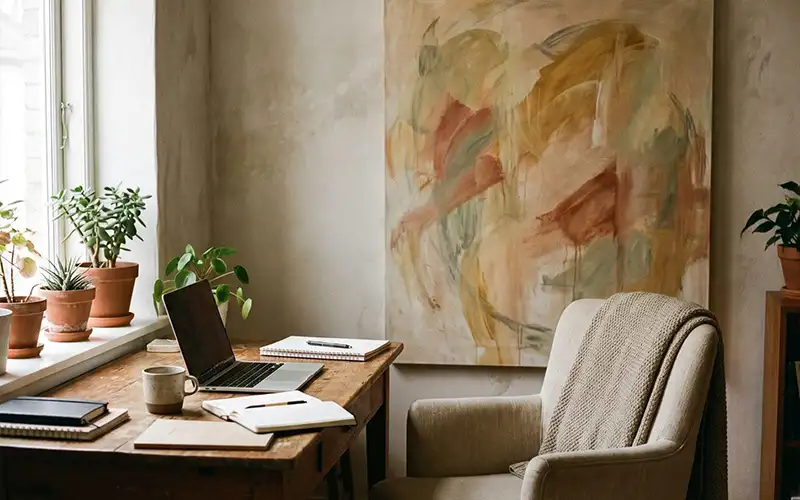
Cozy home office corner with a wooden desk, a laptop and a wide abstract canvas in soft earth tones on the wall behind the chair.
Think about what actually happens in the room. According to the Bureau of Labor Statistics’ American Time Use Survey for 2025, released in June 2026, 81 percent of people did some kind of household activity on an average day, spending about two hours on it. Homes are working spaces, and the art should suit the work.
A bedroom wall wants quiet color and soft edges. A home office wants something your eyes can rest on between emails. A dining room can handle more energy because people are talking, not staring. If you’re not sure, ask which feeling you want when you walk in at 6 p.m. after a long day, then pick the piece that delivers it.
Pull One Color From the Room and Repeat It
The easiest way to make a large piece feel intentional is to borrow a color you already own. Look at the rug, a throw, the ceramic bowl on the shelf. Pick the shade that appears twice, then find art with a touch of it. As with other meaningful decor ideas for your home, the goal is to build around pieces that already have a place in your life rather than making everything match a passing trend.
Texture matters just as much as color. Thick brushwork, layered paint and woven fabrics keep a room from feeling flat. A painting with visible layers can add depth to a plain wall, especially when the surrounding furniture and fabrics are simple. You don’t need lots of different textures, just enough contrast to make the space feel warm and lived in.
Don’t match everything, though. A room where every color is identical looks like a showroom. Aim for one echo, not a full set.
Lighting is the other half of the mood. A picture light or an adjustable wall sconce makes a painting look richer after dark, while a harsh overhead bulb flattens it. If rewiring isn’t an option, a plug-in arm lamp with a warm bulb does the job. Keep direct sunlight off the canvas where you can, since long exposure fades pigment over the years.
FAQs
1. How do you style a large empty wall?
You can style a large empty wall with oversized artwork, a large mirror, framed prints, or a gallery wall. Choose a design that complements your furniture, room colors, and overall decor.
2. What size art is best for a large wall?
Artwork above a sofa should generally be around two-thirds to three-quarters of the sofa’s width. This proportion helps create a balanced and visually appealing look.
3. How high should wall art be hung?
Wall art should usually be centered around 57 inches from the floor. When hanging it above furniture, leave approximately 6 to 8 inches between the furniture and the bottom of the frame.
4. How do you decorate a large wall without making it look cluttered?
Choose one large statement piece and leave enough empty space around it. Avoid adding too many shelves, small frames, or decorative items that compete for attention.
5. How do you choose wall art that matches your room?
Choose artwork that complements one or two colors already present in your room, such as those found in rugs, cushions, curtains, or furniture. Consider the room’s mood and existing textures as well.
6. What type of artwork works best in a living room?
Large abstract paintings, landscape artwork, and modern prints can work well in living rooms. Select a piece that suits your furniture size, color scheme, and personal taste.
7. How can you make a large wall look cozy?
Use artwork with warm colors, textured finishes, and natural tones. Soft lighting, wooden frames, and nearby plants can also make the room feel more inviting.
8. What are the common mistakes to avoid when decorating a large wall?
Common mistakes include choosing artwork that is too small, hanging it too high, ignoring furniture proportions, and overcrowding the wall with decorations. Measuring carefully before hanging artwork can help prevent these issues.