
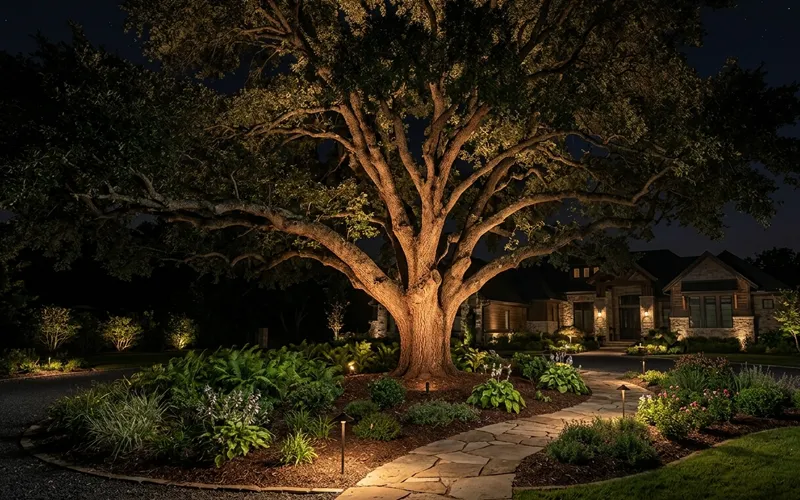
How Mature Trees Change a Landscape Lighting Design Over Time
A tree does not stay where a lighting plan first finds it.
The trunk thickens. Branches extend. Leaves create denser layers. Lower limbs may be removed, new growth fills gaps, and surrounding plants begin competing for space.
A fixture aimed perfectly today can produce a very different effect several years later.
The beam may become blocked by foliage. A branch can cast a new shadow across the trunk. A fixture that once disappeared behind low planting may become exposed as the landscape changes around it.
This is why lighting mature trees should be treated as an evolving design problem rather than a one-time aiming decision.
Table of Contents
ToggleStart With the Tree’s Current Structure
Before considering fixtures, study the tree itself.
Look at the trunk, major branches, canopy shape, and the direction of growth.
Some trees have a strong central trunk that makes an obvious lighting subject. Others spread through several large limbs. Dense canopies behave differently from open branching structures.
The lighting should respond to what makes that particular tree visually interesting.
There is little value in forcing the same uplighting arrangement onto every species or growth form.
Look Beyond the Tree’s Shape Today
Current appearance is only part of the design.
A young or recently planted tree may still have large gaps between branches. A mature tree can have a canopy that becomes denser every season.
That growth changes where light travels.
A beam that currently reaches the upper canopy may eventually be intercepted by lower foliage.
Branches can also move into positions that create heavy shadowing.
Planning for some change from the beginning can reduce the need to redesign the entire setup later.
Record the Future Silhouette, Not Just the Fixture Position
A useful lighting note should describe more than where the fixture sits.
It should record what the tree is expected to become.
A growth-forecast discussion with Astoria Lighting Co can focus on the future silhouette of the tree: where the canopy may thicken, which major branches are likely to cross the beam, and how much of the trunk should remain visible from the primary viewing position as the tree develops.
That information gives future adjustments a reference point.
The original intention remains understandable even after the landscape no longer looks exactly as it did during installation.
Branches Can Redirect the Visual Focus
A large branch can become more prominent over time.
As it grows, it may begin catching more light than the trunk or canopy originally intended as the focal point.
This is not always a problem.
Sometimes the emerging branch becomes one of the tree’s most attractive nighttime features.
What matters most is recognizing how the lighting effect has changed.
If the branch begins dominating the scene unintentionally, the fixture may need to be re-aimed rather than replaced.
Canopy Density Changes Light Distribution
A sparse canopy allows light to travel through gaps.
A dense canopy absorbs and redirects much more of the beam.
As foliage becomes thicker, the upper portion of the tree may appear darker even though the fixture has not changed.
The instinct may be to add another light.
Before doing that, inspect what the existing beam is hitting.
A small aiming adjustment can sometimes restore the intended effect without increasing the number of fixtures.
Seasonal Changes Can Hide Long-Term Problems
A tree may look balanced during one season and completely different during another.
Leafless branches can reveal structure clearly.
Full foliage may block much of the same lighting.
If the design is evaluated during only one part of the year, the result may be misleading.
Check important trees under different seasonal conditions where practical.
The goal is not to make the tree look identical all year.
It is to understand how much the lighting character naturally changes.
Lower Branches Affect Trunk Lighting
Trunk-focused lighting can change dramatically when low branches extend outward.
A branch that once sat above the beam may eventually intercept it.
This can create a bright patch close to the fixture while leaving the upper trunk darker.
Rather than increasing brightness, check the relationship between the beam and the new branch position.
A small shift in angle can often send more light past the obstruction.
The tree’s growth has changed the path, not necessarily the amount of light required.
Root Zones Affect Fixture Placement
Trees change below ground as well as above it.
As roots expand, access around the base can become more complicated.
Fixture placement should not assume that the soil around a tree will remain unchanged forever.
Future maintenance may require enough room to access, adjust, or replace lighting equipment without damaging the tree or surrounding landscape.
A good plan leaves practical working space rather than placing fixtures where future root growth or dense planting makes them difficult to reach.
Nearby Plants Can Change the Beam Too
The tree is not growing alone.
Shrubs, groundcover, and ornamental grasses around it may eventually become large enough to block or scatter the beam.
A fixture that was originally hidden neatly behind low planting can become buried inside dense growth.
That may reduce light output, change the beam shape, or make routine maintenance difficult.
Review the entire planting bed around the tree.
Sometimes the tree itself has not caused the problem at all.
The surrounding landscape has.
The Viewing Position May Stay Fixed While the Tree Moves Visually
A patio chair, window, or walkway may remain in the same place for years.
The tree does not.
As branches expand, the tree can occupy more of the nighttime view.
A feature that once sat comfortably within the scene may begin dominating it.
This is another reason fixture aiming should be revisited.
The original visual balance may no longer fit the larger silhouette.
The tree has changed its role in the composition even though nothing else moved.
Mature Trees Often Need More Selective Lighting
As a tree becomes larger, trying to illuminate the entire canopy evenly can become difficult and visually unnecessary.
Selective lighting may work better.
One portion of the trunk can provide structure.
A few major limbs can create depth.
Part of the canopy can remain darker.
This avoids turning a large tree into a uniformly bright mass.
Mature trees often look more natural at night when light and shadow are allowed to divide the structure.
Pruning Can Change the Lighting Overnight
Landscape growth happens gradually, but pruning can change a tree in a single day.
Removing one major branch may suddenly expose a fixture.
Opening the canopy can send light much farther upward.
Removing lower growth can reveal more trunk.
After meaningful pruning, inspect the lighting before assuming the old aiming still works.
The tree may now need less light, a different angle, or a new visual emphasis.
Landscape maintenance and lighting maintenance are closely connected.
Fixture Visibility Can Increase With Growth Changes
A fixture that was once concealed may become noticeable after planting changes, pruning, or erosion around the tree base.
That matters because visible fixtures can distract from the illuminated subject.
Check important viewing positions periodically.
If the fixture itself is becoming more prominent than the effect it creates, concealment or positioning may need adjustment.
The goal is usually for attention to stay on the tree rather than the equipment producing the light.
Re-Aim Before Expanding the System
When a mature tree stops looking as good as it once did, adding equipment should not be the first step.
Inspect the beam.
Check whether foliage is blocking it.
Look at branch growth.
See whether surrounding planting has changed.
Review the viewing angle.
Many lighting problems that develop over time are alignment problems rather than capacity problems.
Re-aiming an existing fixture can restore the intended composition with far less complexity than adding another light.
Keep a Record of the Original Design Intent
Photos taken after installation can become useful references later.
They show which branches were originally emphasized, how much of the trunk was visible, and what the surrounding planting looked like.
Years later, those images can help explain why the lighting feels different.
The goal is not to force the landscape back to its original appearance.
It is to understand what changed so the design can evolve deliberately rather than through guesswork.
Let the Lighting Mature With the Tree
A tree is one of the least static elements in a landscape.
Its shape, density, scale, and relationship to surrounding plants keep changing.
Outdoor lighting should be able to change with it.
Plan for future branch growth. Leave room for maintenance. Revisit fixture visibility, beam paths, and viewing angles after major pruning or landscape changes.
Most importantly, do not assume that a lighting effect that worked five years ago should still look exactly the same today.
The tree has matured.
The lighting plan should be allowed to mature with it.
FAQs
1. How does tree growth affect landscape lighting?
As trees grow, their branches, leaves, and canopies can block or redirect light. This can change the appearance of the trunk, branches, and canopy.
2. How often should tree lighting be adjusted?
Tree lighting should be checked periodically, especially after major growth, pruning, planting changes, or landscape maintenance.
3. Can mature trees need different lighting than young trees?
Yes. Mature trees often have larger and denser canopies, so selective lighting and different beam angles may work better than the original setup.
4. Should I add more lights when a tree becomes darker?
Not always. First check whether branches or foliage are blocking the existing beam. Re-aiming a fixture may solve the problem without adding another light.
5. Does pruning affect landscape lighting?
Yes. Removing branches can expose fixtures, change the amount of visible trunk, and allow light to travel farther into the canopy.
6. Can nearby plants affect tree lighting?
Yes. Shrubs, grasses, and groundcover can grow around fixtures and block or scatter the light beam.
7. Where should lights be placed around mature trees?
Placement depends on the tree’s structure, viewing angle, trunk, major branches, and surrounding landscape. Fixtures should also remain accessible for future maintenance.
8. Why should mature tree lighting be reviewed over time?
Because trees are constantly changing. Reviewing the lighting helps maintain the intended nighttime appearance as the tree, surrounding plants, and viewing conditions evolve.
Tags