
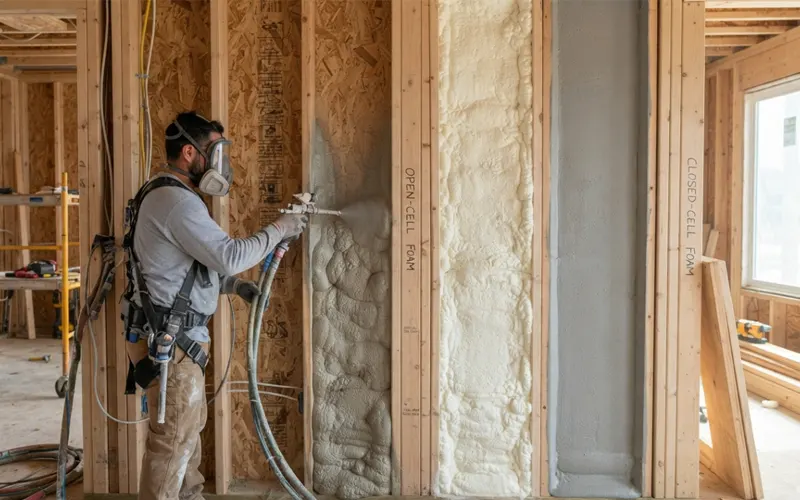
Open-Cell vs. Closed-Cell Spray Foam: A Buyer’s Guide
Spray foam insulation has become one of the most trusted options for homeowners looking to improve energy efficiency, reduce drafts, and create a more comfortable living space. But before you sign a contract with an insulation contractor, it helps to understand the difference between open-cell and closed-cell spray foam. These two products may look similar when they are applied, but they behave very differently once they cure, and choosing the wrong one for your project can lead to wasted money or underperforming insulation.
This guide walks through how each type of spray foam is made, where each one performs best, and how to decide which product is right for your home.
Table of Contents
ToggleWhat Is Spray Foam Insulation?
Spray foam insulation is created by combining two liquid chemical components, typically a polyol resin and an isocyanate, at the job site. When these two materials meet, they react and expand rapidly, forming a foam that fills gaps, cracks, and cavities. Once cured, the foam hardens into a solid material that insulates and seals the treated area at the same time.
The two main categories of spray foam, open-cell and closed-cell, differ primarily in their cell structure, density, and the properties that result from those differences.
What Is Open-Cell Spray Foam?
Open-cell spray foam has a cell structure where the tiny bubbles created during expansion are broken or “open.” This gives the foam a soft, spongy texture. Because air fills the space between the open cells, the material is lighter and more flexible than its closed-cell counterpart.
Key Characteristics of Open-Cell Foam
- Lower density, typically around 0.5 pounds per cubic foot
- Provides an insulation rating of approximately 3.5–3.6 per inch of thickness
- Expands significantly during application, which helps fill irregular spaces
- More affordable than closed-cell foam
- Provides some soundproofing benefits due to its soft texture
Open-cell foam works well for interior walls, attics, and similar spaces where excessive moisture is unlikely to be a concern. Because it is vapor permeable, it allows some moisture to pass through, which can be beneficial in certain climates but may require additional vapor barriers in others.
What Is Closed-Cell Spray Foam?
Closed-cell spray foam has a tighter, denser structure where the cells are fully formed and closed off from one another. This creates a rigid, hard material that is more resistant to moisture, air, and even structural stress.
Key Characteristics of Closed-Cell Foam
- A denser composition, with a typical density of about 2 pounds per cubic foot
- R-value of roughly 6 to 7 per inch, nearly double that of open-cell foam
- Acts as both an insulator and a vapor barrier
- Adds structural rigidity to walls, roofs, and other surfaces
- Higher cost due to denser material and higher chemical usage
Closed-cell foam is commonly used in basements, crawl spaces, roof decks, and exterior walls, especially in areas where moisture resistance and structural strength are priorities.
How Open-Cell and Closed-Cell Spray Foam Differ
Understanding the difference between open-cell and closed-cell spray foam comes down to a handful of core factors: density, R value, moisture resistance, cost, and application.
Density and Texture
Open-cell foam is soft and spongy, while closed-cell foam is rigid and hard. This difference affects not only how each material feels but also how it performs structurally. Closed-cell foam can add meaningful strength to a wall or roof assembly, while open-cell foam does not offer the same structural benefit.
R Value and Insulating Power
Closed-cell foam offers a significantly higher R value per inch than open-cell foam. This means that in spaces with limited depth, such as thin wall cavities, closed-cell foam can achieve a higher level of insulation without needing as much material. Open-cell foam, since it has a lower R value, often requires more thickness to reach the same performance level.
Moisture and Vapor Resistance
Moisture resistance is a key difference between these two foam types. Closed-cell foam blocks most water and water vapor, making it a practical option for damp spaces such as basements and exterior areas. Open-cell foam is vapor permeable, which means moisture can pass through it. This can be an advantage in certain wall assemblies that are designed to dry out, but it can also be a liability in consistently damp environments.
Cost Differences
Open-cell foam is generally less expensive per square foot due to its lower density and reduced material usage during application. Closed-cell foam costs more because it requires more chemical product to achieve its higher density and performance characteristics. For large projects, this cost difference can add up significantly, so it’s important to weigh performance needs against budget constraints.
Application and Expansion
Open-cell foam expands more dramatically during application, sometimes to nearly 100 times its original liquid volume. This makes it useful for filling large or irregular cavities quickly. Closed-cell foam expands less, generally to around 30 to 40 times its original volume, and is applied in thinner layers to build up the desired thickness.
Where Each Type Performs Best
Choosing between open-cell and closed-cell foam often comes down to the specific application and environmental conditions of the space being insulated.
Best Uses for Open-Cell Foam
- Interior wall cavities in moderate climates
- Attic spaces where soundproofing is a priority
- Areas where budget is a primary concern
- Spaces that benefit from some vapor permeability
Best Uses for Closed-Cell Foam
- Basements and crawl spaces prone to moisture
- Roof decks and exterior walls exposed to the elements
- Areas requiring additional structural support
- Cold climates where a higher R-value per inch is beneficial
- Flood-prone areas, since closed-cell foam resists water damage better than most materials
Cost Considerations for Buyers
When budgeting for a spray foam project, it helps to think about both the upfront cost and the long-term value of each option.
Open-cell foam typically costs less per square foot, making it attractive for large areas like attics where a high R value per inch is less critical. Closed-cell foam costs more initially but can offer better long-term value in areas where its moisture resistance and structural benefits reduce the risk of future damage or costly repairs.
It is also worth considering that closed-cell foam’s higher R value may allow for thinner wall assemblies in some new construction projects, which can offset some of its higher material cost by reducing framing requirements in certain designs.
Environmental and Health Considerations
Both open-cell and closed-cell spray foam require professional installation due to the chemicals involved in the application process. Proper ventilation during and after installation is important, and homeowners are typically advised to leave the treated area for a period of time as the foam cures and off-gasses.
From an environmental standpoint, closed-cell foam has historically used blowing agents with a higher environmental impact, though many manufacturers have shifted to more environmentally friendly formulations in recent years. It is worth asking your contractor about the specific blowing agents used in the products they install if environmental impact is a priority for you.
Questions to Ask Your Contractor
Before committing to a spray foam project, homeowners should have a clear conversation with their contractor about the specifics of the job.
- Which type of foam is recommended for this specific area of the home, and why
- What R-value will be achieved based on the planned thickness
- How the contractor plans to manage moisture control in areas prone to dampness
- What ventilation and safety precautions will be taken during installation
- Whether the foam being used meets local fire and building code requirements
Getting clear answers to these questions can help ensure the project meets both performance expectations and safety standards.
Frequently Asked Questions
What is the main difference between open-cell and closed-cell spray foam?
The main difference comes down to density and structure. Open-cell foam is soft, lightweight, and vapor permeable, while closed-cell foam is dense, rigid, and highly resistant to moisture and air movement.
Which type of spray foam has a higher R value?
Closed-cell foam has a higher R value per inch, typically around 6 to 7, compared to roughly 3.5 to 3.6 for open-cell foam. This means closed-cell foam insulates more effectively per inch of material.
Is closed-cell spray foam worth the extra cost?
In areas prone to moisture, extreme temperatures, or structural stress, closed-cell foam often justifies the additional investment. For interior walls or attics in moderate climates, open-cell foam may provide sufficient performance at a lower cost.
Can open-cell foam be used in basements?
Open-cell foam is not typically recommended for basements or other areas with high moisture exposure, since it allows water vapor to pass through. Closed-cell foam is generally the better choice for these environments due to its moisture resistance.
Does spray foam help with soundproofing?
Open-cell foam offers slightly better soundproofing qualities due to its soft, spongy texture, which helps absorb sound. Closed-cell foam provides some sound dampening as well, though it is generally less effective for this purpose than open-cell foam.
How long does spray foam insulation last?
Both open-cell and closed-cell spray foam can last 80 years or more without settling or losing effectiveness when professionals install them correctly and the home avoids major structural changes or water damage.
Making the Right Choice for Your Home
Choosing between open-cell and closed-cell spray foam ultimately depends on the specific needs of your project. If you are insulating an interior space in a moderate climate and want to manage costs, open-cell foam may be the practical choice. If you are dealing with moisture-prone areas, extreme temperatures, or need additional structural reinforcement, closed-cell foam is likely the better long-term investment.
Working with an experienced insulation contractor can help you evaluate your home’s specific needs, climate conditions, and budget to determine which product will deliver the best results. Taking the time to understand these differences upfront can save money, prevent future problems, and ensure your home stays comfortable and energy efficient for decades to come.