


As businesses move more of their operations online, protecting digital information has become an important responsibility. Companies rely on cloud platforms, online transactions, connected networks, and digital customer records to operate efficiently. However, these technologies also introduce security challenges, including phishing attacks, ransomware, data breaches, unauthorised access, and vulnerabilities in software systems.
This has increased the importance of cybersecurity professionals who can identify weaknesses, monitor suspicious activity, investigate incidents, and help organisations protect their digital infrastructure. For students and working professionals interested in technology, cybersecurity offers a way to build practical expertise in an area that continues to evolve.
Delhi provides access to a diverse professional environment, including IT service providers, consulting firms, financial organisations, startups, and large businesses with digital security requirements. For learners exploring a cybersecurity course in Delhi with placement assistance, the important question is not simply what a programme teaches, but how effectively it prepares students to apply their knowledge in practical situations.
Boston Institute of Analytics addresses this learning need through its Cyber Security and Ethical Hacking programme, which combines industry-oriented instruction, practical exercises, project work, individual mentoring, and career support. Its Connaught Place campus also provides learners with an opportunity to connect with an in-person learning environment while accessing resources through its centralised Campus Connect platform.
Why Cybersecurity and Ethical Hacking Skills Matter Today
Cybersecurity is no longer limited to large technology companies. Businesses across industries use digital systems to store customer information, process payments, communicate with employees, and manage operations. Each connected system needs appropriate protection.
A phishing email can expose employee credentials. An incorrectly configured cloud service can leave sensitive information accessible. An unpatched software vulnerability may create an entry point for attackers. Even a small business can experience serious disruption when its systems are compromised.
Cybersecurity professionals work to prevent, detect, and respond to these risks. Depending on their roles, they may monitor security alerts, investigate unusual network activity, assess vulnerabilities, support incident response, or help organisations improve their security policies.
Ethical hacking is an important part of this field. It involves testing systems with proper authorisation to identify weaknesses before malicious attackers can exploit them. Ethical hackers use controlled methods to examine applications, networks, and other digital assets, then document their findings so organisations can address the vulnerabilities.
For beginners, learning the relationship between cybersecurity and ethical hacking provides a useful foundation. Understanding how attacks occur helps explain why particular defensive measures are necessary. Equally, learning how to secure systems helps students understand the practical value of identifying vulnerabilities.
The objective is not to learn how to attack systems indiscriminately. It is to develop the knowledge, judgement, and technical discipline required to test and protect digital environments responsibly.
What Should You Look for in an Ethical Hacking Course in Delhi?
Choosing an ethical hacking course in Delhi requires careful consideration of the curriculum, practical training, trainer support, and opportunities to apply what is learned.

A student practising cybersecurity skills using a laptop in a professional training environment.
Cybersecurity is a broad discipline. A programme that introduces only a few tools may not provide enough context for learners to understand why a vulnerability exists or how it should be addressed. Students benefit from a structured approach that begins with foundational concepts and progresses towards practical security exercises.
A foundation in networking and operating systems
Understanding networks, operating systems, IP addresses, ports, protocols, and access controls is important for cybersecurity work. These concepts help learners understand how devices communicate, where security weaknesses may occur, and how systems can be monitored.
Linux fundamentals, Windows environments, networking principles, and basic scripting can also support further learning. Students do not need to master every topic before beginning, but they should be willing to practise consistently and strengthen their technical foundation.
Vulnerability assessment and penetration testing
Vulnerability assessment involves identifying weaknesses in systems and applications. Penetration testing goes further by testing whether selected weaknesses can be exploited under an authorised and defined scope.
A structured course should help learners understand how assessments are planned, how findings are documented, and how remediation recommendations are developed. Practical exercises in controlled environments can help students connect theoretical concepts with actual security scenarios.
Network security and incident response
Network security involves protecting connected systems through appropriate configurations, access controls, monitoring, and other safeguards. Incident response focuses on identifying, investigating, containing, and recovering from security incidents.
Learning these areas helps students understand the defensive side of cybersecurity. It also introduces the importance of evidence collection, documentation, escalation procedures, and communication during an incident.
Practical exposure to security tools
Cybersecurity professionals use different tools to inspect systems, analyse traffic, test applications, and investigate suspicious activity. The tools required depend on the role and the task being performed.
More importantly, learners need to understand what a tool does, how to interpret its output, and how to verify the results. Practical exercises should reinforce responsible testing, legal authorisation, and safe handling of information.
At Boston Institute of Analytics, the Cyber Security and Ethical Hacking programme includes more than 200 hours of learning and practical exercises, 15 or more projects and case studies, and exposure to 20 or more tools and technologies. These components provide opportunities to connect core concepts with practical learning.
Campus Connect: Extending Learning Beyond the Classroom
A cybersecurity course should offer more than scheduled classes. Students need a reliable way to revisit lessons, access learning resources, clarify doubts, and keep track of their progress.
This is where Campus Connect, Boston Institute of Analytics’ centralised learning platform, becomes an important part of the learning experience.
Campus Connect provides access to study materials, recorded lectures, guest lectures, a help desk, and the Career Enhancement Cell. Having these resources available through a central platform helps learners organise their studies and return to difficult topics when additional practice is needed.
Cybersecurity requires continuous learning because tools, vulnerabilities, attack methods, and defensive techniques change over time. Students may need to revisit networking concepts while completing a project or review a recorded explanation before attempting a practical exercise.
Access to learning materials and recorded sessions can make this process easier, particularly when learners need to balance their studies with college, work, or other responsibilities.
Campus Connect also brings learning and career support into a more connected experience. Instead of treating classroom instruction, academic assistance, and career preparation as completely separate activities, students can access relevant resources through a centralised system.
For someone comparing the best hacking course in Delhi, this kind of learning support is worth considering alongside the curriculum and classroom experience. The ability to revisit lessons, seek help, and access career resources can be valuable throughout the learning journey.
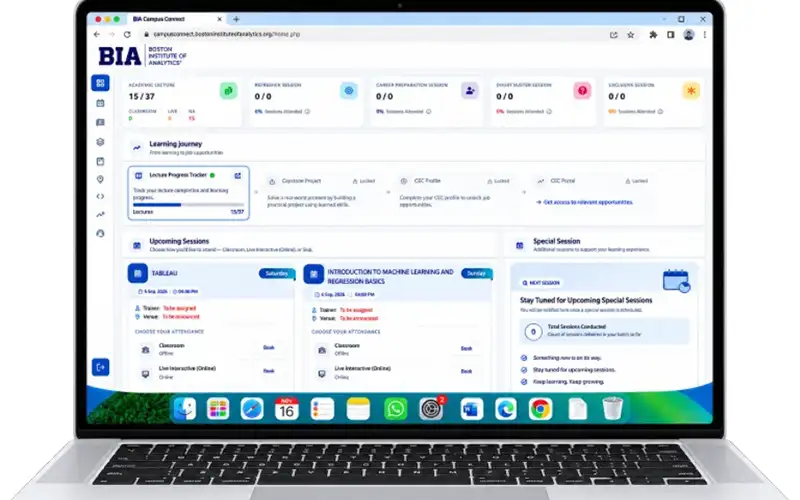
A laptop dashboard representing online learning resources and academic support for cybersecurity students.
Why One-to-One Mentoring Makes a Difference
Cybersecurity can be challenging for beginners because different concepts often build on one another. A student who struggles with networking fundamentals may find penetration testing exercises difficult. Another learner may understand the theory but need additional practice interpreting tool outputs or documenting vulnerabilities.
Individual mentoring can help address these differences.
Boston Institute of Analytics offers one-to-one career mentorship as part of its learning and career-support approach. Personalised sessions provide an opportunity to discuss individual learning goals, clarify areas of difficulty, and seek guidance on career preparation.
For example, a learner interested in penetration testing may need guidance on developing a suitable project portfolio. Someone considering a security operations centre role may want to understand the fundamentals of log analysis, incident handling, and security monitoring.
Mentoring can also help learners identify gaps in their knowledge and decide which areas require further practice. During career preparation, students can seek guidance on presenting projects, explaining technical decisions, and preparing for interviews.
The value of mentoring lies in making learning more focused. Instead of following the same pace in every area, learners can use guidance to concentrate on the concepts and professional skills they need to strengthen.
Hands-On Projects: Turning Theory Into Practical Experience
Cybersecurity knowledge becomes more useful when students can apply it to realistic problems. Reading about a vulnerability is different from identifying it in a controlled environment, understanding its impact, and documenting how it should be resolved.
Practical projects can help learners develop this understanding.
For example, a network security exercise may involve examining traffic in a lab environment and identifying unusual communication patterns. A vulnerability assessment project could involve testing an intentionally vulnerable application within an authorised environment and preparing a report with recommended fixes.
Students can also explore incident response scenarios, access-control weaknesses, basic log analysis, and security configuration reviews. Each exercise helps develop a different aspect of the security process.
Project work also encourages habits that matter in professional environments. Learners must follow defined procedures, record their observations, distinguish evidence from assumptions, and explain their findings clearly.
These experiences can become useful examples during interviews. A candidate who can explain the problem addressed by a project, the methods used, the results obtained, and the limitations encountered is better prepared to demonstrate practical understanding.
Boston Institute of Analytics incorporates projects and case studies into its cybersecurity training, giving learners opportunities to practise concepts and build familiarity with security tools and workflows.
All testing exercises should remain within authorised lab environments or systems for which explicit permission has been granted. Responsible practice is a fundamental part of ethical hacking.
Internships and On-the-Job Training: Building Workplace Readiness
One of the challenges faced by aspiring cybersecurity professionals is gaining experience that goes beyond classroom learning. Employers may expect candidates to understand technical concepts, but they also value the ability to apply those concepts, follow procedures, communicate findings, and work through practical problems.
Internships and structured workplace training can help learners develop these capabilities.
Boston Institute of Analytics offers different learning pathways for its Cyber Security and Ethical Hacking programme. The four-month certification focuses on building foundational knowledge, while the six-month diploma includes a guaranteed two-month internship. The ten-month master diploma pathway includes six months of on-the-job training.
These pathways give prospective students options based on their learning objectives and the depth of training they want to pursue. The internship and on-the-job training components are particularly relevant for learners who want to gain practical exposure as part of their learning journey.
During an internship, students may have opportunities to become familiar with professional workflows, understand how teams approach technical problems, and improve their documentation and communication. The exact responsibilities depend on the internship assignment and the organisation’s requirements.
This practical exposure can also help students understand which areas of cybersecurity interest them most. Some may prefer vulnerability assessment and penetration testing, while others may be more interested in network defence, security monitoring, or incident response.
When comparing the best cyber security course in Delhi with 100% placement as a search option, learners should look carefully at what each institute actually offers. Guaranteed internships, placement assistance, on-the-job training, and guaranteed employment are different commitments. Understanding these distinctions helps students make informed decisions.
Placement Assistance: Preparing for Cybersecurity Careers
Completing a course is one part of preparing for a cybersecurity career. Students also need to understand the recruitment process, identify suitable entry-level roles, and communicate their abilities to prospective employers.
Boston Institute of Analytics provides placement assistance through career guidance, resume-building support, interview preparation, and access to partner-company opportunities. Its Career Enhancement Cell is intended to support students as they work towards their professional goals.
This support can be valuable for fresh graduates who may have limited interview experience and for working professionals who want to transition into cybersecurity from another field.
Resume preparation and portfolio development
A cybersecurity resume should highlight relevant knowledge, tools, projects, certifications, and practical experience. Rather than listing technical terms without context, candidates should explain what they have worked on and what they learned.
For example, a learner who has completed a vulnerability assessment project should be able to explain the testing environment, the weaknesses identified, the potential impact, and the recommended corrective measures.
Project documentation can help demonstrate a candidate’s approach to problem-solving. It also provides useful material for discussing technical decisions during an interview.
Technical interview preparation
Cybersecurity interviews may cover networking, operating systems, security fundamentals, vulnerability assessment, incident response, and practical problem-solving. The specific topics depend on the position.
Interview preparation can help students practise explaining concepts clearly, answering scenario-based questions, and discussing the reasoning behind their project work.
Candidates should also understand professional responsibilities, including confidentiality, authorisation, and the importance of following established security procedures.
Access to employment opportunities
Career support can help students identify relevant vacancies and understand the expectations associated with different roles. However, eligibility and recruitment decisions depend on the employer, the candidate’s preparation, and the requirements of the position.
Placement assistance is therefore best understood as structured support during the job search rather than a guarantee that every student will receive an offer.
For students looking for a cybersecurity course in Delhi with placement assistance, it is worth asking about the specific career services, internship arrangements, employer connections, and interview preparation included in the programme.
Cybersecurity Career Opportunities and Company Examples
Cybersecurity includes several career paths, each with different responsibilities and technical requirements. Understanding these roles can help learners decide which areas to prioritise during their training.
A security operations centre analyst monitors security alerts, investigates suspicious activity, and helps escalate potential incidents. A junior security engineer may assist with security configurations, vulnerability remediation, and the maintenance of protective systems.
An ethical hacker or penetration tester evaluates systems within an authorised scope to identify exploitable weaknesses. Other roles focus on network security, information security, governance, risk, compliance, and incident response.
Boston Institute of Analytics student success stories featuring graduates who have progressed into cybersecurity-related positions at organisations such as Audible, Dell Technologies, Lenovo, HCL Technologies, Rapid7, Qualys, RedPoint Cyber Security, Fortinet, and McAfee.
Student stories feature:
- Ava P., who is profiled as a SOC Analyst at Audible after completing the Cyber Security and Ethical Hacking course.
- Nathan S., whose story describes a move into a Junior Security Engineer role at Dell Technologies.
- Samantha C., whose story describes joining Lenovo as a Junior Security Analyst.
- Mryaanshi D., whose published testimonial describes working at HCL Technologies as an Information Security Specialist.
- Sophia C., whose success story describes joining Rapid7 as a Security Analyst.
These examples illustrate some of the career directions represented in the institute’s published student stories. They should not be interpreted as a guarantee of similar outcomes for every learner. Individual results depend on a candidate’s preparation, experience, performance, and the requirements of the hiring organisation.
For prospective students, the more useful lesson is to understand the capabilities associated with each role and identify how a course’s curriculum, practical work, internship opportunities, and career support align with those requirements.
What Students Say About Their Learning Experience
Student experiences can provide additional context when evaluating a training programme. In cybersecurity, useful feedback often focuses on practical exercises, trainer guidance, the relevance of the curriculum, and support during career preparation.
Boston Institute of Analytics features student testimonials that discuss these aspects of its Cyber Security and Ethical Hacking programme.
For example, Nathan S. highlights industry-relevant curriculum content and the value of mock interviews and resume workshops in preparing for recruitment. His profile identifies a Junior Security Engineer role at Dell Technologies.
Another success story features Mitali R., who describes how weekly doubt-buster sessions and ongoing Career Enhancement Cell support helped her during her learning and placement journey. Her profile identifies a Network Security Associate role at Cognizant.
The institute also publishes a testimonial from Alexa P., whose story highlights the importance of an industry-oriented curriculum and describes her experience progressing into a Security Engineer role at RedPoint Cyber Security.
These accounts offer examples of the learning and career-support experiences students have shared. Prospective learners can explore the institute’s published testimonials for further details and should consider them alongside the syllabus, course structure, mentoring arrangements, and internship conditions.
Considering these questions provides a more meaningful basis for evaluating a course than relying on placement claims alone.
How to Choose the Best Hacking Course in Delhi for Your Goals
The right course depends on the learner’s starting point and professional objectives. Someone new to technology may need a structured introduction to networking, operating systems, and security fundamentals. A learner with IT experience may want to focus more heavily on penetration testing, security operations, or advanced technical exercises.
Before enrolling, consider the following factors.
Curriculum relevance: Check whether the syllabus covers foundational security concepts, ethical hacking, vulnerability assessment, network defence, and practical exercises suited to your target role.
Hands-on learning: Ask how projects are structured, which tools are covered, and whether students practise in controlled environments.
Trainer access: Find out whether trainers are available to clarify technical questions and whether individual mentoring is offered.
Learning resources: Consider whether recorded lectures, study materials, and academic support are available when you need to revisit a topic.
Internship details: Verify the duration, eligibility, terms, and structure of any guaranteed internship or on-the-job training pathway.
Career support: Review the actual placement assistance provided, including resume preparation, interview practice, career guidance, and access to relevant opportunities.
Course suitability: Compare programme duration, prerequisites, certification, and learning format with your current experience and availability.
Boston Institute of Analytics offers its Cyber Security and Ethical Hacking programme at its Connaught Place campus in Delhi, with classroom and online learning options. Its Campus Connect platform, one-to-one mentoring, practical projects, internship pathways, and career-support services provide several factors for prospective students to evaluate.
Rather than choosing a programme solely because it uses the words “best” or “100% placement” in its advertising, learners should assess the quality of the training and the practical support they can expect.
Conclusion
Cybersecurity is a field in which theoretical knowledge and practical application need to work together. Understanding networks, identifying vulnerabilities, analysing suspicious activity, and recommending appropriate security measures all require consistent practice and careful reasoning.
For students and working professionals exploring an ethical hacking course in Delhi, the learning experience matters as much as the course title. Practical exercises, accessible learning resources, individual mentoring, internships, and career preparation can help learners build a stronger foundation for entering the field.
Boston Institute of Analytics combines these elements through its Cyber Security and Ethical Hacking programme. Campus Connect supports access to study materials and recorded sessions, one-to-one mentoring provides individual guidance, and the programme’s internship and on-the-job training pathways offer options for additional practical exposure.
Its placement assistance further supports learners through resume preparation, interview practice, career guidance, and access to employment opportunities.
Ultimately, the right cybersecurity programme should help learners understand how digital systems are protected, practise relevant techniques responsibly, and demonstrate their knowledge through meaningful projects. By evaluating these factors carefully, aspiring professionals can make a more informed choice about their cybersecurity training and the career paths they wish to pursue.
FAQs
- Which is the best cybersecurity course in Delhi with placement assistance?
The best cybersecurity course in Delhi depends on the curriculum, practical training, industry-relevant projects, mentoring, and career support offered. Boston Institute of Analytics offers a Cyber Security and Ethical Hacking programme with hands-on learning, Campus Connect resources, one-to-one mentoring, internship pathways, and placement assistance.
- What can I learn in an ethical hacking course in Delhi?
An ethical hacking course in Delhi may cover networking fundamentals, operating systems, vulnerability assessment, penetration testing, network security, and security tools. Practical exercises in authorised environments help learners understand how vulnerabilities are identified, assessed, and addressed.
- Does Boston Institute of Analytics provide internships and placement assistance for cybersecurity students?
Yes, Boston Institute of Analytics offers guaranteed internship and on-the-job training pathways through specified programme options, along with placement assistance. Career support may include resume preparation, mock interviews, career guidance, and access to employment opportunities. Internship duration and eligibility depend on the selected programme.
- What is Campus Connect at Boston Institute of Analytics?
Campus Connect is a centralised learning platform that provides access to resources such as study materials, recorded lectures, guest lectures, a help desk, and career support through the Career Enhancement Cell. It helps students revisit lessons and access learning resources during their training.
- What career opportunities can I pursue after a cybersecurity and ethical hacking course?
After completing relevant cybersecurity training, learners may explore roles such as Security Operations Centre (SOC) Analyst, Junior Security Engineer, Information Security Analyst, Network Security Associate, and Penetration Tester. Eligibility depends on the role, technical knowledge, practical experience, and employer requirements.