
When people start looking for a beautiful gemstone for a ring, two names often come up: moissanite and diamond. Both can look bright, elegant, and attractive, but they are not the same stone. They have different origins, different structures, different levels of hardness, and different ways of reflecting light. The price can also be very different, which is one reason many jewelry buyers want to understand the difference before making a purchase.
A moissanite vs diamond comparison can be useful for anyone shopping for an engagement ring, wedding ring, or everyday jewelry. At first glance, the two stones can look very similar, especially when they are well cut. However, you can notice differences when you look closely at their sparkle, color, light reflection, and overall appearance. Their durability is also slightly different, although both are suitable for regular jewelry use.
This guide explains the main differences in simple language. It covers appearance, sparkle, hardness, cost, sunlight, engagement rings, and comparisons with lab-grown diamonds and cubic zirconia. The goal is not to say that one stone is right for everyone. Instead, understanding the differences can help you decide which option fits your style, needs, and budget.
What Is Moissanite and How Is It Different From Diamond?
Moissanite is a gemstone made from silicon carbide. Natural moissanite is extremely rare, so most moissanite used in modern jewelry is created in laboratories. It was first discovered in a meteorite crater, which gives the stone an interesting connection with space. Today, laboratory-created moissanite is carefully made to produce the clear and attractive stones used in rings, earrings, necklaces, and other jewelry.
Diamond, on the other hand, is made from carbon. Natural diamonds form deep inside the Earth under very high pressure and temperature over extremely long periods. Diamonds can also be created in laboratories. Lab-grown diamonds have the same basic chemical composition and crystal structure as natural diamonds, although their origin is different.
So, what is moissanite vs diamond really about? It is mainly a comparison between two different gemstones that can serve similar purposes in jewelry. They may look alike from a distance, but their optical properties and physical structures are different.
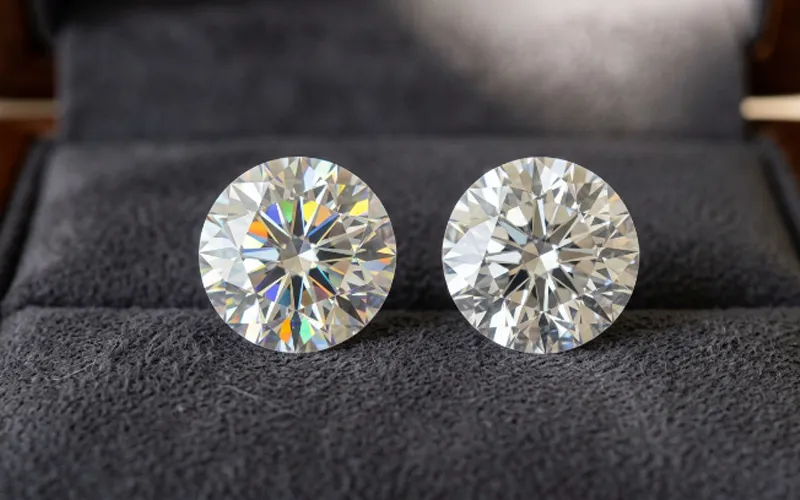
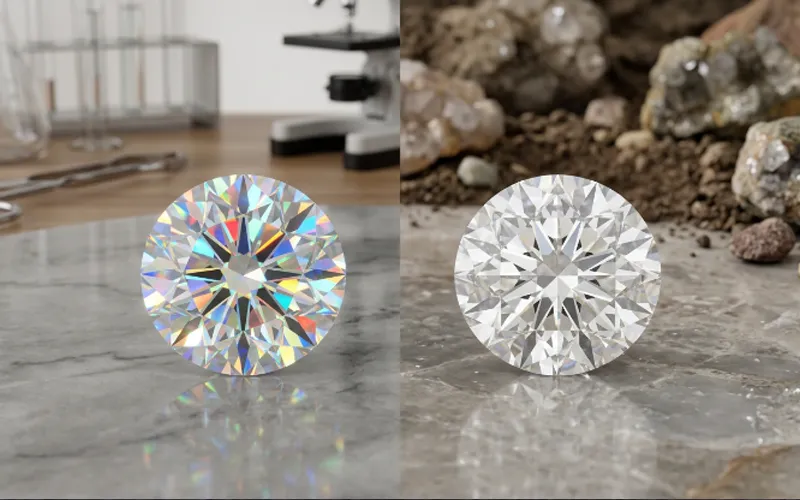
Moissanite usually produces more colorful flashes when it catches light. Diamond tends to have a more balanced combination of white light and smaller flashes of color. This difference is especially noticeable in larger stones or under strong lighting.
moissanite vs diamond
Moissanite vs Diamond Side by Side
A moissanite vs diamond side by side comparison makes the differences easier to understand. Both gemstones can be cut into similar shapes, including round, oval, pear, cushion, emerald, and princess cuts. Their appearance can therefore seem almost identical when viewed quickly.
The biggest visual difference often comes from the way each stone handles light. Moissanite has strong fire, which means it can show noticeable flashes of rainbow colors. Diamond also has fire, but its light pattern is generally different and can appear more white and crisp.
Another difference is hardness. Diamond ranks at 10 on the Mohs hardness scale, making it the hardest natural mineral. Moissanite is around 9.25 on the same scale. This means diamond has greater resistance to scratching, but moissanite is still very hard and durable for everyday jewelry.
Price is another major difference. Natural diamonds can be expensive depending on their carat weight, cut, color, clarity, and origin. Moissanite is generally much less expensive for a similar-looking size. This price difference is one of the main reasons buyers consider it as an alternative to diamond.
Understanding the Sparkle Difference
One of the most common reasons people compare these gemstones is their sparkle. When light enters a gemstone, it can be reflected and separated into different colors. The way this happens depends on the stone’s optical properties and its cut.
In a moissanite vs diamond sparkle comparison, moissanite is known for strong fire. This means you may see more rainbow-like flashes when the stone moves under light. Some people love this colorful appearance because it makes the gemstone look lively and dramatic.
Diamond also produces sparkle, but its appearance can be more balanced. A well-cut diamond can show bright white flashes, along with smaller flashes of color. The final look depends heavily on the cut, because even a high-quality gemstone can look less impressive if it has a poor cut.
This is why it is not always fair to compare sparkle only by the material. Cut quality, shape, size, lighting, and viewing angle all influence how a gemstone looks. Two stones made from the same material can have very different levels of brightness because they were cut differently.
What Happens to Both Stones in Sunlight?
People often ask about moissanite vs diamond in sunlight because direct sunlight can reveal a gemstone’s optical behavior very clearly.
In direct sunlight, moissanite can produce strong rainbow flashes. The colors may become more noticeable when the stone is moved or when the angle of the sunlight changes. This can give moissanite a very lively appearance.
Diamonds can also look extremely bright in sunlight. Their facets can reflect strong white light and produce flashes of color. However, the pattern usually looks different from moissanite because the two gemstones have different optical properties.
Sunlight can therefore be a useful way to compare the stones, but it should not be the only test. Jewelry store lighting is often designed to make gemstones look especially bright, while natural outdoor lighting can show a different side of the stone.
How Hard Is Each Gemstone?
Hardness matters because rings and other jewelry can come into contact with many surfaces during everyday life. Scratches can change the appearance of a gemstone over time.
In the moissanite vs diamond hardness comparison, diamond has the higher rating. Diamond scores 10 on the Mohs scale, while moissanite is around 9.25. Because of this difference, diamond has greater resistance to scratching.
Still, moissanite is considered a very hard gemstone. Its hardness makes it suitable for engagement rings and other jewelry that people may wear regularly. It does not mean that moissanite is fragile or unsuitable for daily use.
The hardness of moissanite vs diamond is therefore a difference worth knowing, but it should be viewed in context. Both are durable choices. Diamond simply has the advantage when it comes to resistance to scratching.
Comparing Prices Before You Buy
Price is often one of the first things people consider when choosing between these gemstones. A moissanite vs diamond price comparison can show a large difference, but there is no single price for either stone.
Diamond prices can change significantly based on the four Cs: cut, color, clarity, and carat weight. Natural diamonds can also vary in price depending on other factors, such as certification and market demand. Lab-grown diamonds are generally priced differently from natural diamonds.
Moissanite usually costs less than a comparable diamond, especially when you compare stones of similar visual size. This means a buyer may be able to choose a larger moissanite stone without spending as much money as they would on a diamond.
The moissanite vs diamond cost difference can make moissanite appealing to people who want a large, bright gemstone while keeping more money available for other parts of the ring or their overall budget.
Why Carat Size Can Be Confusing
When comparing gemstone prices, size needs some attention. Diamonds are commonly described using carat weight. Moissanite can also be sold with carat-related information, but its density is different from diamond.
Because of this, two stones that look similar in diameter may not have exactly the same weight. Some moissanite sellers use carat equivalent measurements to help customers understand how the stone compares visually with a diamond.
This means buyers should not look only at the carat number. Measurements such as length and width can be more useful when comparing the visible size of different gemstones.
For someone shopping online, checking the actual dimensions can make the comparison much easier. A stone that looks large on paper may not have the same visual size as another stone with a different material.
Moissanite vs Diamond for an Engagement Ring
The moissanite vs diamond engagement ring discussion has become common because both stones can be used in beautiful ring designs. They are available in many cuts and settings, so the final style can be customized in many ways.
A diamond engagement ring has a long history and is strongly connected with traditional engagement jewelry. Some buyers like the classic appearance, natural origin, and cultural meaning associated with diamonds.
Moissanite offers a different approach. It can provide a bright and colorful sparkle while usually costing less than a comparable diamond. This can make it attractive to people who care more about appearance and budget flexibility than having a traditional diamond.
The setting also matters. A simple solitaire setting can make either gemstone the main focus, while halo and three-stone settings can create a different overall appearance. Metal color, ring shape, and stone cut can change the way the gemstone looks.
How to Tell Moissanite vs Diamond
Learning how to tell moissanite vs diamond can be difficult when the stones are small or viewed quickly. They can look very similar to the untrained eye.
One visible clue can be the type of fire. Moissanite often shows stronger rainbow flashes, while diamond may produce a different combination of white brilliance and colored fire. However, lighting and cut can change what you see, so visual inspection alone is not always reliable.
Traditional diamond testers also need to be used carefully because some testing methods are based on thermal or electrical properties. Moissanite can sometimes react differently from diamond, and certain testers are designed specifically to distinguish between them.
For a valuable purchase, professional testing and proper documentation are more reliable than trying to identify the stone by eye.
Moissanite vs Diamond vs Lab Diamond
The moissanite vs diamond vs lab diamond comparison adds another important option. Lab-grown diamonds are not the same as moissanite. A lab-grown diamond has the same basic carbon crystal structure as a natural diamond. The main difference is where it was formed.
Moissanite is a different gemstone made from silicon carbide. It can look similar to diamond, but it has different optical and physical properties.
Lab-grown diamonds can therefore provide a diamond option without being mined from the Earth. Their prices can also be lower than natural diamonds, although pricing depends on the specific stone and market.
For buyers, the choice between these three options often comes down to what matters most to them. Some may prefer a natural diamond, some may want a lab-grown diamond, and others may prefer moissanite because of its appearance and price.
Moissanite vs Diamond vs Cubic Zirconia
Another common comparison is moissanite vs diamond vs cubic zirconia. Cubic zirconia, often called CZ, is a different material from both moissanite and diamond.
Cubic zirconia is widely used as an affordable diamond alternative. It can be very clear and attractive when new, but it is softer than both diamond and moissanite. Its lower hardness means it can develop scratches more easily with regular wear.
Moissanite sits between diamond and cubic zirconia in terms of hardness. It is much harder than CZ and is generally more suitable for jewelry intended for frequent use.
The three stones also have different patterns of light reflection. CZ can have attractive sparkle, while moissanite is known for strong fire and diamond has its own distinctive balance of brilliance and dispersion.
Choosing the Right Cut for Your Style
The cut of a gemstone can have a major effect on its appearance. Round cuts are popular because they are designed to create strong light return. Oval cuts can provide a larger-looking appearance while giving the ring a different shape.
Cushion, pear, emerald, radiant, and princess cuts also create different visual effects. Some cuts show colorful fire more strongly, while others create a cleaner and more elegant appearance.
This is important when considering a moissanite vs diamond ring. The material is only one part of the final look. The cut, proportions, setting, metal, and lighting all work together.
A buyer who wants a traditional appearance may prefer a classic round stone. Someone who wants a more noticeable and modern look may choose an elongated shape such as an oval or pear.
Why Cleaning Can Change the Look of a Stone
A gemstone can lose some of its sparkle when oil, dust, soap, or other residue builds up on its surface. This can make a stone appear dull even when there is nothing wrong with the gemstone itself.
Both diamond and moissanite benefit from regular cleaning. A clean stone allows light to enter and leave the facets more effectively, which can improve its visual brightness.
This is another reason not to judge a gemstone based on a single viewing. A dirty stone can look very different from the same stone after proper cleaning.
Simple jewelry care can therefore have a noticeable effect on appearance, especially for rings that are worn every day.
Final Thoughts
Moissanite and diamond are both beautiful gemstones, but they differ in sparkle, hardness, appearance, and price. Moissanite offers strong colorful fire and lower cost, while diamond provides classic brilliance and greater hardness.
When choosing moissanite vs diamond, consider your preferred sparkle, budget, ring style, and how often you plan to wear it. Both can be excellent choices when selected carefully.
Frequently Asked Questions
1. What is the difference between moissanite vs diamond?
Moissanite is made from silicon carbide, while diamond is made from carbon. They also differ in sparkle, hardness, appearance, and price.
2. Is moissanite cheaper than diamond?
Yes, moissanite is generally much less expensive than a comparable diamond. This allows buyers to choose a larger stone while keeping the overall cost lower.
3. Does moissanite sparkle more than diamond?
Moissanite can show more colorful rainbow flashes because it has higher fire. Diamond usually gives a more balanced mix of white brilliance and colored sparkle.
4. Is moissanite as hard as diamond?
No. Diamond has a hardness of 10 on the Mohs scale, while moissanite is around 9.25. Both are hard enough for everyday jewelry, but diamond is more resistant to scratches.
5. How can you tell moissanite vs diamond?
The two stones can look very similar, but their sparkle and light reflection are different. Professional testing is the most reliable way to identify them.
6. Is moissanite good for an engagement ring?
Yes, moissanite is a popular choice for engagement rings because it is durable, bright, and usually costs less than diamond.
7. How does moissanite compare with a lab-grown diamond?
Moissanite and lab-grown diamonds are different gemstones. A lab-grown diamond has the same basic composition as a natural diamond, while moissanite is made from silicon carbide.
8. What is the difference between cubic zirconia, moissanite, and diamond?
Diamond is the hardest of the three, while moissanite is also highly durable. Cubic zirconia is softer and generally costs less, while moissanite is known for its strong colorful sparkle.